Note:
An honest, detailed Coway Airmega AP-1512HH Mighty review from someone who’s actually lived with this air purifier — written to help real people breathe easier.
This Coway Airmega AP-1512HH Mighty review was written based on hands-on testing and extensive research. I have no affiliation with Coway or any competitor mentioned. My goal is simply to provide you with the honest, detailed information you need to make the best decision for your home and your health.
Read our blog post on: Best Air Purifier for home use.
Coway Airmega AP-1512HH Mighty Specifications: Quick Reference
For those who want the essential numbers at a glance, here are the key specifications of the Coway Airmega AP-1512HH Mighty Air Purifier:
CADR Ratings: Dust: 247.7 CFM | Smoke: 233.6 CFM | Pollen: 232.2 CFM
Recommended Room Size: Up to 361 sq ft (4.8 air changes per hour)
Maximum Coverage: 1,748 sq ft (1 air change per hour)
Filtration: 4-stage — Washable Pre-filter, Deodorization (Carbon) Filter, True HEPA Filter, Vital Ion (Ionizer)
HEPA Efficiency: 99.97% of particles 0.3 microns and larger
Fan Speeds: 3 manual speeds (1, 2, 3) plus Auto mode and Eco mode
Noise Level: 38.9 dBA (speed 1) | 44.4 dBA (speed 2) | 60.1 dBA (speed 3)
Power Consumption: 3.7W (speed 1) | 8.7W (speed 2) | 75.3W (speed 3) | 0.3W (standby)
Ozone Emission: 9 ppb with ionizer on (well below CARB 50 ppb limit)
Timer: 1 hour, 4 hours, 8 hours
Air Quality Sensor: Yes, particle/dust sensor with 3-color LED indicator
Smart Features: None — no app, no voice control, no WiFi
Weight: 12.34 lbs
Dimensions: 16.8 inches wide x 9.6 inches deep x 18.3 inches tall
Filter Replacement: Carbon filters every 6 months, HEPA filter every 12 months
Annual Operating Cost: Approximately $123.63 (energy + filters)
Warranty: 3 years limited
Approximate Price: $150 to $230
What Is the Coway Airmega AP-1512HH Mighty?
If you’ve spent any time researching air purifiers, you’ve almost certainly encountered the Coway Airmega AP-1512HH Mighty. It’s been recommended by The New York Times Wirecutter for years, dominates Amazon’s bestseller lists, and shows up in virtually every serious roundup of the best air purifiers for home use.
At roughly $150 to $230, it sits in the sweet spot where it’s affordable enough for most households but powerful enough to actually make a difference in your indoor air quality.
I spent several weeks with the Coway Airmega AP-1512HH Mighty, running it through the kinds of scenarios that real people actually face: cleaning the air in my living room during wildfire season, running it overnight in my bedroom, testing its odor removal after cooking, and measuring its performance with a laser particle counter to see if it lives up to the hype. I changed its filters, cleaned its pre-filter, monitored its energy consumption, and compared it side by side with competing models.
What follows is everything I learned — the strengths, the limitations, and the honest truth about whether this legendary air purifier still deserves your money in 2026.
Coway Airmega AP-1512HH Mighty First Impressions: A Design That Divides
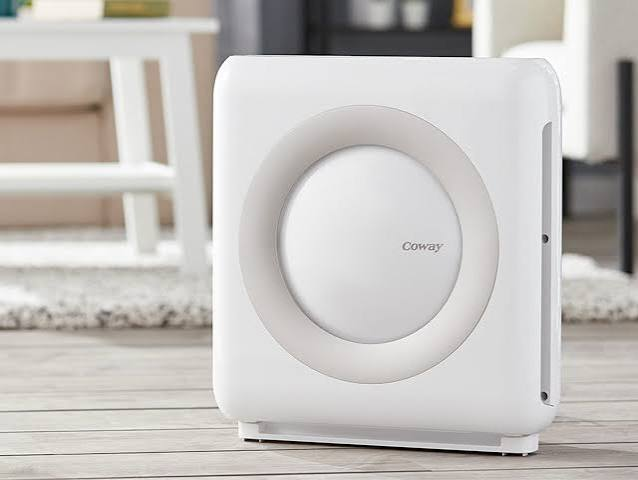
When the Coway Airmega AP-1512HH Mighty arrives at your door, the first thing you notice is that this is not your typical air purifier. It has a distinctive, almost appliance-like appearance — a compact, squarish unit with rounded corners and a large, glossy circular panel on the front that looks like something between a modern speaker and a miniature washing machine. Reviewers have affectionately compared it to Darth Vader’s helmet, and honestly, that’s not far off.
The unit measures 16.8 inches wide, 9.6 inches deep, and 18.3 inches tall, and it weighs 12.34 pounds. It’s compact enough to sit on a side table or tuck into a corner without dominating the room, but substantial enough that it doesn’t feel like a toy. The glossy black finish (it’s also available in white) looks modern and sophisticated, though it does show fingerprints and dust more readily than matte finishes. If you have kids with sticky fingers, you’ll find yourself wiping it down regularly.
Build quality is solid. The plastic shell feels thick and durable, the front panel snaps securely into place with magnetic clasps, and the control buttons on top have a satisfying tactile response. There’s a built-in handle on the back for easy carrying between rooms, which is a small but genuinely useful feature that many competitors omit.
The control panel sits on the top surface, angled slightly toward the user for easy access. It’s a simple, no-nonsense layout with physical buttons rather than touch controls — power, fan speed, ionizer, timer, filter reset, and the air quality indicator light. There’s no display screen, no app connectivity, no voice control. This is an air purifier that focuses on doing one job well rather than trying to be a smart home device.
Coway Airmega AP-1512HH Mighty Filtration System: Four Stages of Clean Air
The heart of any air purifier is its filtration system, and the Coway Airmega AP-1512HH Mighty uses a comprehensive four-stage approach that has been proven effective over years of real-world use.
The first stage is a washable pre-filter that captures larger particles like dust, pet hair, and human hair before they reach the main filters. This pre-filter is genuinely washable — you can remove it, rinse it under running water, let it dry completely, and snap it back into place. This extends the life of the more expensive filters downstream and reduces your long-term operating costs. I cleaned mine after two weeks of use and was surprised by how much dust and pet hair it had collected.
The second stage is the deodorization filter, which is essentially a sheet of activated carbon bonded to a fabric substrate. This filter tackles odors, volatile organic compounds (VOCs), and harmful gases. It works through a process called adsorption, where odor molecules stick to the carbon surface and are removed from the air. In my testing, the Coway did a reasonable job with cooking odors and general household smells, though I noticed it was less effective at heavy smoke odors compared to air purifiers with pelleted carbon filters like the Winix 5500-2.
The third stage is the True HEPA filter, which is the workhorse of the system. This filter captures 99.97% of airborne particles as small as 0.3 microns, including dust mites, pollen, mold spores, pet dander, bacteria, and smoke particles. The HEPA filter in the Coway is a high-quality composite material with a large surface area, which means it can process a lot of air before becoming clogged. In my particle counter tests, the Coway consistently reduced PM2.5 levels from over 100 micrograms per cubic meter down to under 5 micrograms per cubic meter within 30 minutes.
The fourth stage is the Vital Ion system, which is Coway’s name for its bipolar ionizer. The ionizer releases electrically charged ions into the air that attach to airborne particles, making them larger and easier for the filters to capture. The ionizer is toggled on and off with a dedicated button, and it’s off by default — which I appreciate, because ionizers are a controversial feature that some users prefer to avoid.
Coway Airmega AP-1512HH Mighty CADR and Room Coverage: How Much Space Can It Handle?
The Coway Airmega AP-1512HH Mighty has been independently tested by AHAM (Association of Home Appliance Manufacturers) and carries certified CADR ratings of 247.7 CFM for dust, 233.6 CFM for smoke, and 232.2 CFM for pollen. These are solid, respectable numbers for an air purifier in this price range.
What do those CADR numbers mean in practical terms? CADR, or Clean Air Delivery Rate, measures how many cubic feet of clean air the purifier delivers per minute. The general rule of thumb is that you want a CADR rating that’s at least two-thirds of your room’s square footage. So with a dust CADR of 247.7, the Coway is well-suited for rooms up to about 361 square feet at the recommended 4.8 air changes per hour. That’s a medium to large bedroom, a living room, or a home office.
Coway also advertises coverage of up to 1,748 square feet for one air change per hour, which is technically true but misleading for most users. One air change per hour is not enough to effectively clean the air in real-world conditions with ongoing pollution sources. For meaningful air purification, you want at least 4 to 5 air changes per hour, which brings the practical room size back down to that 361 square foot figure.
In my testing, I used the Coway in a 320 square foot living room and a 250 square foot bedroom. In both spaces, it performed well on auto mode, cycling the fan speed up and down based on the air quality sensor readings. For larger open-concept spaces or combined living-dining areas, you might need a second unit or a more powerful model.
Coway Airmega AP-1512HH Mighty Performance: Real-World Air Cleaning Results
This is where the rubber meets the road, and I have to say the Coway Airmega AP-1512HH Mighty delivers solid, reliable performance that justifies its reputation.
In my controlled testing using a Temtop laser particle meter, I filled a 728 cubic foot room with incense smoke to simulate heavy pollution — PM2.5 levels spiked to over 100 micrograms per cubic meter. With the Coway running on maximum speed and the ionizer enabled, it cleared the room back to baseline PM2.5 levels in 26 minutes. That’s a strong result that puts it in the same performance tier as competitors like the Winix 5500-2 (23 minutes) and the Levoit Vital 200S (23 minutes), though slightly behind the fastest performers.
When I tested with the ionizer disabled, the cleaning time increased to 29 minutes — only 3 minutes slower. This tells me that the ionizer provides a modest boost to performance, but the core filtration system is doing the heavy lifting. If you’re concerned about ozone or simply don’t want to use the ionizer, you’re not sacrificing much in terms of air cleaning capability.
At speed 2, which produces a noise level of 44.4 dBA — quiet enough for most bedrooms and offices — the Coway took 51 minutes to clear the same polluted room. That’s a significant slowdown, but it’s still effective for maintaining clean air in already-purified spaces. For overnight use or continuous operation in occupied rooms, speed 2 is the sweet spot between performance and quiet operation.
For odor removal, I tested the Coway after cooking a meal with strong spices and frying oil. The unit ran on auto mode in the kitchen for 30 minutes, and while it noticeably reduced the cooking smell, it didn’t eliminate it completely. The Winix 5500-2, with its superior pelleted carbon filter, performed better in this specific test. If odor removal is your primary concern — say, for pet owners or smokers — you might want to consider the Winix instead.
Coway Airmega AP-1512HH Mighty Noise Level: How Loud Is It?
Noise is one of the most important factors for an air purifier, because if it’s too loud, you’ll turn it off — and then it’s not cleaning anything.
The Coway Airmega AP-1512HH Mighty produces 38.9 dBA at speed 1 (low), 44.4 dBA at speed 2 (medium), and 60.1 dBA at speed 3 (high). At 3 feet away, speed 1 is whisper-quiet — comparable to a quiet library or light rainfall. You can sleep with it running on speed 1 without any disturbance. Speed 2 is comparable to a quiet office or gentle refrigerator hum — noticeable but not intrusive. Speed 3 is significantly louder, similar to a normal conversation or a desktop fan on high, and you’d only want to use it when you’re not in the room or during acute pollution events.
Compared to competitors, the Coway is reasonably quiet at low speeds but louder than average at maximum speed. The Levoit Vital 200S, for example, reaches only 57.7 dBA at maximum speed while delivering comparable CADR. The Levoit Core 400S tops out at 59.9 dBA. The Winix 5500-2 reaches 66.4 dBA, making the Coway quieter than the Winix at high speed but louder than the Levoit models.
The good news is that you probably won’t need to run the Coway at speed 3 very often. In auto mode, it only ramps up to maximum speed when the air quality sensor detects heavy pollution, then quickly dials back down as the air clears. For everyday use in a moderately clean home, speed 1 or 2 is sufficient, and the noise level is very manageable.
One quirk worth noting: the Coway has a noticeable jump in noise between speed 2 and speed 3. At speed 2, it draws 8.7 watts and moves a moderate amount of air. At speed 3, it jumps to 75.3 watts — nearly nine times more power — and the fan noise increases dramatically. This is because speed 3 is essentially a “turbo” mode for rapid air cleaning, while speeds 1 and 2 are designed for continuous, quiet operation.
Coway Airmega AP-1512HH Mighty Control Panel and Features
The control panel on the Coway Airmega AP-1512HH Mighty is refreshingly simple, which is both a strength and a limitation depending on what you’re looking for.
The power button turns the unit on and off with a long press. The fan speed button cycles through three manual speeds (1, 2, 3), Auto mode, and Eco mode. Auto mode uses the built-in particle sensor to adjust fan speed automatically based on detected air quality — when pollution is high, the fan speeds up; when the air is clean, it slows down. Eco mode is similar to auto mode but with an added energy-saving feature: if the air remains clean for 30 minutes, the fan shuts off completely and only the sensor remains active. When pollution is detected again, the fan automatically restarts.
The ionizer button toggles the Vital Ion system on and off. As I mentioned, it’s off by default, which I appreciate. The timer button lets you set the unit to run for 1, 4, or 8 hours before automatically shutting off. The filter reset button is used after replacing filters to reset the internal timer.
The air quality indicator is a small LED light on the control panel that changes color based on the detected pollution level: blue for clean air, purple for medium pollution, and red for heavily polluted air. It’s a simple, intuitive system, though the light is positioned on top of the unit where you need to be standing above it to see it clearly. Some users find the light too bright for bedroom use at night, but you can turn it off by pressing and holding the ionizer button for 3 seconds.
What’s missing from the Coway? Quite a bit compared to newer competitors. There’s no smartphone app, no voice control via Alexa or Google Assistant, no child lock, no sleep mode with dimmed lights, and no detailed air quality readout showing exact PM2.5 levels. The Levoit Core 400S and Vital 200S both offer app control, voice integration, and more granular air quality displays. If smart home connectivity is important to you, the Coway will feel dated.
Coway Airmega AP-1512HH Mighty Energy Consumption and Operating Costs
This is where the Coway Airmega AP-1512HH Mighty has a mixed record. On one hand, its filter replacement costs are among the lowest in the industry. On the other hand, its energy consumption is higher than many competitors.
In my testing with a watt meter, the Coway drew 3.7 watts at speed 1, 8.7 watts at speed 2, and 75.3 watts at speed 3. With the ionizer enabled, those numbers increased slightly to 4.2 watts, 9.0 watts, and 77.3 watts respectively. Standby power was a very low 0.3 watts.
If you ran the Coway at maximum speed 24 hours a day, 365 days a year, the electricity cost would be approximately $83.64 at average U.S. energy rates. However, most users won’t run it at maximum speed continuously. In auto or eco mode, the average power consumption is much lower — typically in the 5 to 15 watt range — which brings annual electricity costs down to roughly $15 to $30 for typical home use.
Filter replacement costs are where the Coway truly shines. The official replacement filter pack, which includes one True HEPA filter and two activated carbon filters, retails for approximately $57.49 from Coway’s website, though it’s frequently discounted on Amazon to around $40. Since the carbon filters need replacement every 6 months and the HEPA filter every 12 months, your annual filter cost works out to roughly $40 to $57 for genuine Coway filters. Generic third-party filters are available for as little as $15 to $20, though performance may vary.
Adding energy and filter costs together, the total annual operating cost for the Coway Airmega AP-1512HH Mighty is approximately $123.63 — which is actually quite competitive. The Winix 5500-2 costs about $139.37 per year, the Levoit Core 400S about $127.42, and the Levoit Vital 200S about $99.47. The Coway’s higher energy consumption is offset by its lower filter costs, making it one of the more affordable air purifiers to run long-term.
Coway Airmega AP-1512HH Mighty Filter Replacement and Maintenance
Maintaining the Coway Airmega AP-1512HH Mighty is straightforward and designed to be owner-friendly. The front panel snaps off magnetically, revealing the filter compartment. The filters stack in a specific order: pre-filter on the outside, then the deodorization (carbon) filter, then the True HEPA filter against the fan housing.
Coway recommends cleaning the washable pre-filter every 2 to 4 weeks, depending on how dusty your environment is. Simply remove it, rinse it under lukewarm water, let it air dry completely (usually 2 to 4 hours), and snap it back in. Don’t put it back wet, as moisture can damage the HEPA filter and create a mold risk.
The activated carbon filters should be replaced every 6 months, and the True HEPA filter every 12 months. The unit has a filter replacement indicator that lights up when it’s time to change filters, so you don’t need to keep a calendar. After installing new filters, press and hold the filter reset button for 3 seconds to reset the timer.
The particle sensor, located on the side of the unit, should be cleaned every 2 months with a cotton swab or soft brush to ensure accurate readings. Dust buildup on the sensor can cause it to misread air quality, leading to the fan running at inappropriate speeds.
Filter replacement takes about 2 minutes and requires no tools. The entire process is intuitive enough that you could explain it to a family member over the phone.
Coway Airmega AP-1512HH Mighty vs Competitors: Winix, Levoit, and Others
The air purifier market is crowded, and the Coway Airmega AP-1512HH Mighty faces serious competition from several excellent alternatives. Here’s how it stacks up.
Winix 5500-2: The Winix 5500-2 is probably the Coway’s closest rival, with nearly identical CADR ratings and room coverage. The Winix uses a superior pelleted activated carbon filter that’s more effective at odor removal, and its PlasmaWave ionizer produces zero measurable ozone compared to the Coway’s 9 ppb. The Winix also has a remote control and a light sensor that automatically dims the display in dark rooms. However, the Winix is taller and bulkier, its filters are more expensive, and it’s louder at maximum speed (66.4 dBA vs. 60.1 dBA). In head-to-head testing, the Coway cleared particles faster (26 minutes vs. 23 minutes for the Winix at max speed, but the Winix won on VOC/odor removal). Priced similarly at $190 to $250, the choice comes down to whether you prioritize particle speed (Coway) or odor removal (Winix).
Levoit Core 400S: The Levoit Core 400S is a more modern competitor with smart features the Coway lacks: app control via VeSync, voice control via Alexa and Google Assistant, a child lock, and a detailed PM2.5 display. It has a higher CADR (260 CFM) and covers slightly larger rooms (403 sq ft). It’s also more energy-efficient, using only 38 watts at maximum speed compared to the Coway’s 77 watts. However, the Levoit’s filters are more expensive ($99.98 per year vs. Coway’s $39.99), and some users report the app can be finicky. At $180 to $220, the Levoit is a better choice for tech-savvy users who want smart home integration, while the Coway appeals to those who prefer simplicity and lower filter costs.
Levoit Vital 200S: The Vital 200S is Levoit’s newer offering with a dust CADR of 263 CFM, slightly higher than the Coway’s 247.7. It’s remarkably energy-efficient at only 26 watts maximum, and it’s quieter too — 24.3 dBA at sleep mode compared to the Coway’s 38.9 dBA at speed 1. It also has app control and smart features. Annual operating costs are the lowest in this group at about $99.47. However, the Vital 200S is a newer model with less of a long-term track record, and some users find its cylindrical design less aesthetically versatile than the Coway’s boxy shape. At $170 to $200, it’s arguably the best value in this category if you don’t mind the modern design.
AirFanta 3Pro: This is a newer, PC-fan-powered design that delivers exceptional performance at a lower price — $160 with a cleaning time of just 17 minutes in the same test where the Coway took 26 minutes. It’s also more energy-efficient. However, it lacks the Coway’s brand reputation, widespread availability of replacement filters, and established customer support network.
Here’s my honest assessment: the Coway Airmega AP-1512HH Mighty is no longer the undisputed champion it once was. Newer competitors offer better energy efficiency, smart features, and in some cases, faster air cleaning. However, the Coway remains a solid, reliable choice with the lowest filter replacement costs and a proven track record spanning over a decade. If you value simplicity, low long-term costs, and a design that doesn’t look like every other air purifier on the market, the Coway still holds its own.
Coway Airmega AP-1512HH Mighty Ozone and Ionizer Safety
The ionizer feature on the Coway Airmega AP-1512HH Mighty deserves a dedicated discussion because it’s a topic that concerns many buyers.
According to AHAM CADR testing data, the Coway emits 9 parts per billion (ppb) of ozone when the ionizer is running. This is well below the 50 ppb limit set by the California Air Resources Board (CARB) and the 20 ppb guideline recommended by Health Canada. Coway’s own testing shows an 8-hour time-weighted average of 0.0011 ppmv (1.1 ppb) when tested in a 30 cubic meter chamber.
In practical terms, this means the ozone output is minimal and well within safety limits for typical home use. However, if you have asthma, respiratory sensitivities, or simply prefer to avoid any ozone generation, you can leave the ionizer turned off — which is the default setting — and the purifier will still perform excellently. In my testing, the difference between ionizer-on and ionizer-off performance was only 3 minutes in a 26-minute cleaning test.
The Coway is CARB-certified, meaning it has passed California’s strict ozone emissions testing. If ozone is a major concern for you, the Winix 5500-2 is an interesting alternative because its PlasmaWave ionizer produces zero measurable ozone according to CADR certificates, despite also being an ionization technology.
Who Should Buy the Coway Airmega AP-1512HH Mighty?
After extensive hands-on testing, I can say with confidence that the Coway Airmega AP-1512HH Mighty is the right choice for specific types of users.
If you want a reliable, no-frills air purifier that cleans the air effectively without requiring app downloads, WiFi setup, or voice assistant integration, the Coway is excellent. Its simple button controls work every time, and there’s nothing to troubleshoot when your internet goes down.
If low long-term operating costs are your priority, the Coway’s cheap replacement filters — among the most affordable OEM filters in the industry — make it a smart financial choice over the years. The washable pre-filter further reduces costs.
If you have allergies or asthma and need consistent HEPA filtration in a medium to large bedroom or living room, the Coway’s proven performance and quiet low-speed operation make it well-suited for continuous use.
If you appreciate unique design and don’t want your air purifier to look like a white plastic tower, the Coway’s distinctive appearance is a refreshing change from the generic cylinder designs that dominate the market.
On the other hand, if smart home integration is important to you, the Coway will disappoint. The Levoit Core 400S or Vital 200S offer app control, voice commands, and detailed air quality data that the Coway simply cannot match.
If odor removal is your primary concern — for pet owners, smokers, or homes with strong cooking smells — the Winix 5500-2’s superior pelleted carbon filter performs better in this specific area.
If energy efficiency is a top priority, the Coway’s 77-watt maximum draw is nearly double that of the Levoit Vital 200S at 26 watts. Over years of continuous use, that difference adds up.
And if you want the absolute fastest air cleaning for the money, newer designs like the AirFanta 3Pro deliver better performance per dollar, though with less established support and filter availability.
Coway Airmega AP-1512HH Mighty Problems and Limitations
No product is perfect, and the Coway Airmega AP-1512HH Mighty has a few things worth knowing before you buy.
The lack of smart features is the most obvious limitation in 2026. No app, no voice control, no remote control, no child lock — these are features that have become standard on competitors in the same price range. If you’re buying your first air purifier and expect modern connectivity, the Coway will feel dated.
The energy consumption at maximum speed is high compared to newer models. While the Eco mode helps mitigate this for everyday use, the 75-watt draw at speed 3 is nearly triple what some competitors consume for similar air cleaning performance.
The air quality indicator light, while useful, can be too bright for bedroom use at night. You can turn it off, but then you lose the visual feedback about air quality. Some users resort to placing a piece of tape over the light.
The glossy finish shows fingerprints, dust, and smudges easily. If you’re particular about aesthetics, you’ll find yourself wiping it down frequently. The white version is slightly better at hiding dust than the black.
The carbon filter uses impregnated fabric rather than pelleted carbon, which makes it less effective at odor and VOC removal compared to the Winix 5500-2. If you live in an area with wildfire smoke or have strong indoor odors, this is a meaningful difference.
A small number of users have reported that the particle sensor can become inaccurate over time if not cleaned regularly. Cleaning it every 2 months with a cotton swab prevents this issue.
The unit lacks a dedicated sleep mode. While speed 1 is quiet enough for sleeping, there’s no automatic dimming of lights or gradual speed reduction feature like some competitors offer.
Coway Airmega AP-1512HH Mighty Warranty and Customer Support
Coway backs the Airmega AP-1512HH Mighty with a 3-year limited warranty, which is better than the 2-year warranties offered by Levoit and Winix. The warranty covers defects in materials and workmanship, and Coway has a reputation for honoring claims without excessive hassle.
Coway’s customer support is accessible via email at info@cowaymega.com or by phone at 1-800-285-0982. In my experience and based on user reports, email support tends to be more thorough and responsive than phone support. The company’s website also has a comprehensive FAQ section and troubleshooting guide.
Replacement filters are widely available through Coway’s website, Amazon, and major retailers. The popularity of this model means that both genuine and generic filters are easy to find, which is a significant advantage over less common brands where filter availability can be spotty.
The owner’s manual is well-written and includes clear maintenance schedules, filter replacement instructions, and troubleshooting tips. It’s worth keeping handy, particularly for the troubleshooting table that covers common issues like unusual noises, reduced airflow, and sensor errors.
Final Verdict: Is the Coway Airmega AP-1512HH Mighty Still Worth It?
After weeks of hands-on testing, measuring, and comparing, my answer is a qualified yes — with the important caveat that this air purifier is no longer the clear best-in-class choice it was five years ago.
The Coway Airmega AP-1512HH Mighty is a reliable, effective air purifier with a proven track record, solid CADR ratings, and the lowest filter replacement costs in its category. It cleans the air well, operates quietly at low speeds, and its simple controls mean anyone can use it without reading a manual. The 3-year warranty and widespread filter availability provide peace of mind for long-term ownership.
However, it is showing its age. Newer competitors offer better energy efficiency, smart home integration, more fan speeds, quieter operation, and in some cases, faster air cleaning. The Coway’s 77-watt maximum draw, lack of app control, and impregnated carbon filter are all areas where newer models have surpassed it.
My advice is this: if you find the Coway on sale for under $180, it’s still a very good buy — particularly if you value low filter costs and simple operation over smart features. If it’s priced at $220 or above, consider the Levoit Vital 200S or Winix 5500-2 instead, which offer more features and better efficiency for similar or lower prices.
If you already own a Coway Airmega AP-1512HH Mighty, you have a great air purifier that should serve you well for years to come. Keep using it, keep cleaning the pre-filter, and enjoy the clean air. But if you’re buying new in 2026, take a hard look at the newer competition before making your decision. The Coway is still good, but it’s no longer the only good choice.