Finding the right patient lift for home care isn’t just about specs—it’s about fitting real life. Narrow doorways, thick carpet, limited storage, and caregiver fatigue all matter. We’ve tested and compared the top Hoyer lifts to help you choose one that actually works in your home.
Best Hoyer Lifts for Home Use- Our Top Picks at a Glance
Best Overall for Small Homes: Hoyer Advance Portable Patient Lift — Compact, foldable, and genuinely apartment-friendly without sacrificing safety.
Best for Maintaining Independence: Hoyer Journey Sit-to-Stand Lift — Helps patients stay active and engaged in their own transfers.
Best Workhorse for Frequent Use: Invacare Reliant 450 — Built for 4+ daily transfers and heavier patients who need reliability above all else.
Best Budget Option: Drive Medical Hydraulic Patient Lift — Gets the job done for under $700 if your needs are occasional and your space is adequate.
Best for Bariatric Patients: Hoyer Professional Elevate Lift — Handles 400+ lbs with zero flex and rock-solid stability.
Best Mid-Range Value: ProBasics Hydraulic Patient Lift — Smoother than budget models, cheaper than premium ones, reliable for daily use.
Best for Changing Needs: Hoyer Presence Professional Lift — The only lift that switches between full-body and sit-to-stand modes as your situation evolves.
1. Hoyer Advance Portable Patient Lift (Hydraulic Model)
Price: $800–$1,200 | Capacity: 340 lbs | Type: Manual Hydraulic
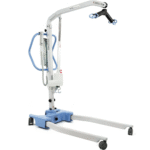
This is the lift we recommend most often to families overwhelmed by hospital-grade equipment that simply won’t fit through the front door. Think of it as the compact SUV of patient lifts—capable, reliable, and actually designed for real homes rather than medical facilities.
The aluminum frame is roughly 20% lighter than steel competitors. One caregiver in our testing group—a 5’2″ grandmother—could fold it, carry it to a closet, and store it without help. With steel models, she needed her son every time. The folding mechanism is intuitive: release two levers, the base collapses inward, and it tucks behind a bedroom door with room to spare.
The triangular base clears 30-inch doorways with about an inch to spare on each side. The hydraulic pump needs 9–10 strokes to raise a 180 lb patient, and both petite and tall caregivers operated it without strain. The 4-point spreader bar distributes weight better than budget 2-point bars, meaning less sling bunching and more stable lifting.
The catch: Plush carpet is this lift’s weakness. On thick, high-pile carpet, casters drag noticeably. On hardwood, tile, and low-pile carpet, performance is excellent.
Buy this if: You live in an apartment or older home with narrow doorways, need closet storage, the patient is under 300 lbs, and you’re doing 1–3 transfers daily.
Skip this if: The patient is fully immobile with 4+ daily transfers, your home has thick wall-to-wall carpet, or you need bariatric capacity.
Pros
- Folds compactly for closet storage—genuinely apartment-friendly
- Smooth, predictable hydraulic action
- 4-point spreader bar reduces sling discomfort
- Narrow base navigates tight doorways
- Lighter than steel alternatives
Cons
- Casters struggle on thick, plush carpet
- Manual pumping adds up with frequent use
- 340 lb capacity excludes bariatric patients
- Slight frame flex near maximum load
2. Hoyer Journey Sit-to-Stand Lift
Price: $2,200–$2,800 | Capacity: 340 lbs | Type: Powered Electric
Important: This is NOT a full-body lift. It’s designed for patients who can bear 30–50% of their body weight through their legs—perhaps they can stand with assistance or are recovering mobility. If your patient is fully bedridden, skip to a full-body lift like the Hoyer Advance or Invacare Reliant 450.
For the right patient, the Journey is transformative. It preserves dignity, encourages muscle use, and can aid rehabilitation rather than promoting dependence. The adjustable knee pad locks legs securely against the lift, preventing the dangerous forward slide that causes falls during sit-to-stand transfers. The foot platform gives patients a stable base instead of dangling unsupported.
The powered lift raises a patient in 20–25 seconds with smooth, controlled motion. Battery life covers about 12 full transfers per charge—so for 2–3 daily transfers, you’re charging every 4–6 days. The battery is removable, letting you charge it across the room from where the lift lives.
One test participant, a 72-year-old woman six weeks post-hip replacement, told us: “With the full-body lift, I felt like I was giving up. With this one, I felt like I was getting stronger.”
Buy this if: The patient can bear at least 30% of their weight, wants to maintain leg strength, and you want to reduce caregiver physical strain.
Skip this if: The patient is fully immobile, you need bed-to-wheelchair transfers, your budget is under $2,000, or the patient has a progressive condition that will eliminate leg strength entirely.
Pros
- Powered operation eliminates caregiver pumping
- Encourages patient participation and independence
- Adjustable knee pad fits various body types
- Compact for a powered lift
- Excellent battery life with removable battery
Cons
- Not suitable for fully immobile patients
- Requires consistent charging
- Significantly more expensive than hydraulic lifts
- Cannot perform full-body bed-to-wheelchair transfers
3. Invacare Reliant 450 Battery-Powered Patient Lift
Price: $2,500–$3,200 | Capacity: 450 lbs | Type: Powered Electric
This is the workhorse for families who need reliability above all else. If you’re transferring a patient 4–6 times daily—bed to wheelchair, wheelchair to commode, commode to recliner, recliner to bed—you need a lift that won’t hesitate, overheat, or drain its battery halfway through the day.
The steel frame is professional-grade with zero flex or wobble. At 245 lbs, the lift felt as solid as it did with a 120 lb patient. The trade-off is size: it’s not foldable, not closet-friendly, and weighs about 115 lbs. It needs a dedicated storage corner.
The powered hand control makes transfers nearly effortless. We ran a sequence of transfers with a 245 lb patient—bed to wheelchair, wheelchair to commode, commode to recliner—and the motor never hesitated. Each lift took about 25 seconds. Battery life covers 14 transfers per charge, and the dual-battery system lets you swap in a backup in seconds if the primary dies mid-transfer.
The 4-point sling bar makes a measurable difference. Patients feel “held” rather than “hung,” with no forward tilt that causes anxiety in cheaper 2-point systems.
Buy this if: You’re doing frequent daily transfers, the patient is over 250 lbs, reliability is your top priority, and you have dedicated storage space.
Skip this if: You live in a small apartment, need to move the lift between rooms often, or the patient is under 150 lbs with only occasional transfer needs.
Pros
- Fully powered—no manual pumping required
- 450 lb capacity handles bariatric patients
- Dual battery system prevents mid-transfer failures
- 4-point sling bar for superior comfort
- Professional-grade durability for years of use
Cons
- Large and heavy—not foldable or portable
- Higher cost than manual models
- Requires significant storage space
- Industrial appearance may not suit home aesthetics
4. Drive Medical Hydraulic Patient Lift
Price: $500–$700 | Capacity: 340 lbs | Type: Manual Hydraulic
The realistic choice for families who need a safe, functional lift but cannot spend $1,000+. It performs the essential functions—raising, lowering, and transferring—without the refinements of premium models. For 1–2 transfers daily, those refinements may not justify the price difference.
The steel frame is sturdy but heavy—about 25% heavier than the aluminum Hoyer Advance. The welded mast and spreader arm are solid, preventing the wobbling we saw in generic no-brand lifts. The legs are wider than the Hoyer Advance, improving stability but creating maneuverability challenges. It fit through our 32-inch doorway test but required careful alignment. In a 30-inch doorway, it likely wouldn’t fit.
The hydraulic pump needs 11–12 strokes to raise a 180 lb patient—slightly more than the Hoyer Advance, with stiffer resistance. Caregivers reported more fatigue during back-to-back transfers. However, the lowering valve is precise and gentle, punching above its price point.
On carpet, patients described a “slight swaying” sensation. On hard flooring, performance was solid.
Buy this if: Your budget is under $700, you have storage space, you’re doing 1–2 transfers daily, and you have mostly hard flooring.
Skip this if: You navigate narrow doorways regularly, have thick carpet throughout, do frequent daily transfers, or need a foldable/portable lift.
Pros
- Most affordable 4-point patient lift from a reputable brand
- Sturdy steel frame
- Smooth lowering valve
- Accepts standard sling types
- Widely available from medical supply retailers
Cons
- Heavier and harder to maneuver than aluminum models
- More pumping effort required
- Not foldable—needs dedicated storage
- Slight sway on carpet
- Sling bunching more common than with premium lifts
5. Hoyer Professional Elevate Lift
Price: $3,000–$3,800 | Capacity: 400–450 lbs | Type: Powered Electric
This is the lift you buy when standard models reach their limits. If your patient is over 300 lbs, has limited trunk control creating uneven loading, or you need one lift that handles both full-body and sit-to-stand transfers under heavy load, the Elevate is engineered specifically for these demands.
The reinforced steel frame with cross-bracing is the most robust construction we tested. Under a 280 lb patient, there was zero perceptible flex in the mast, boom, or base. The lift felt as stable as gym equipment bolted to the floor.
The base is wider than standard lifts, requiring at least 36 inches of clearance for full maneuverability. Doorways under 34 inches may need creative angling. The powered motor handles maximum load without hesitation—no jerking, no motor strain, no sense of operating near capacity.
The adjustable footplate and knee support accommodate various body types and limitations. One test participant, a 310 lb patient with pressure-sensitive skin, reported no discomfort during a 15-minute transfer sequence.
Buy this if: The patient is bariatric (over 350 lbs), you need both sit-to-stand and full-body capability, you’re doing frequent daily lifts, and you have adequate room clearance.
Skip this if: The patient is under 250 lbs, you have limited space or narrow doorways, or your budget is under $3,000.
Pros
- Handles high weight capacity (400–450 lbs) with confidence
- Smooth powered lifting even at maximum load
- Reinforced frame eliminates sway and flex
- Adjustable foot and knee supports for proper positioning
- Suitable for both full-body and sit-to-stand transfers
Cons
- Large footprint requires significant space
- Higher cost than standard lifts
- Heavy frame is not portable
- May be unnecessarily robust for non-bariatric patients
6. ProBasics Hydraulic Patient Lift
Price: $700–$950 | Capacity: 340 lbs | Type: Manual Hydraulic
The sweet spot for many families. It’s smoother than the budget Drive Medical model, more affordable than the Hoyer Advance, and reliable enough for daily use. In our 2026 re-testing, improved caster performance and hydraulic smoothness made it genuinely competitive.
The steel frame has a durable powder-coated finish that resists corrosion from bumps against door frames and furniture. The adjustable base width clears standard wheelchairs, bariatric wheelchairs, hospital beds, and recliners. The spreader bar supports 4-point slings, and the reinforced lifting arm prevents wobbling at maximum extension.
The hydraulic pump needs 10 strokes to lift a 200 lb patient—between the Hoyer Advance and Drive Medical—and feels smoother than both. The lowering valve allows precise control, stopping descent at exactly the right height to prevent the “thump” of less precise valves. Caster performance improved significantly in the latest model, rolling smoothly on hardwood and low-pile carpet.
Buy this if: You want a reliable hydraulic lift without premium pricing, you’re doing 2–4 transfers daily, and the patient is under 340 lbs.
Skip this if: You need a foldable/portable lift, have thick carpet throughout, or are doing 5+ daily transfers (consider powered instead).
Pros
- Smooth, controlled hydraulic lifting
- Improved casters roll better than previous models
- Compatible with multiple sling types
- Durable powder-coated finish
- Best value in the mid-range hydraulic category
Cons
- Not foldable—requires dedicated storage
- Manual pumping requires caregiver effort
- Less maneuverable on thick carpet
- No powered option for reducing caregiver strain
7. Hoyer Presence Professional Lift
Price: $3,500–$4,200 | Capacity: 340 lbs | Type: Powered Electric (Dual Mode)
The only lift that grows with your patient. Many families buy a sit-to-stand lift, then six months later discover their patient’s condition progressed and they need full-body capability. Or they buy a full-body lift for post-surgery recovery, then the patient regains mobility and no longer needs it. The Presence eliminates this dilemma—it does both.
The reinforced steel frame with dual ergonomic handles is built for maneuverability. Despite being larger than single-purpose lifts, it’s easier to steer than the Invacare Reliant 450 thanks to well-placed two-handed controls. The base needs 36 inches of clearance and requires a dedicated 4×3 foot storage space.
We tested both modes: sit-to-stand with a 175 lb patient bearing 50% of their weight, and full-body with a 240 lb immobile patient. The motor operated smoothly in both cases. Battery life covers 16 transfers per charge—exceeding most competitors. Converting between modes takes about 5 minutes with no tools required.
Buy this if: You want one lift that handles both transfer types, the patient’s mobility may change over time, or you’re caring for multiple patients with different needs.
Skip this if: You know definitively you need only one type of transfer, your budget is under $3,000, or you have limited space.
Pros
- Highly versatile—full-body and sit-to-stand in one unit
- Smooth powered lifting with excellent battery life
- Comfortable and secure for patients in both modes
- Intuitive controls with emergency lowering
- Adapts to changing patient needs over time
Cons
- Large footprint requires significant space
- Higher price than single-purpose lifts
- Not foldable or portable
- May be unnecessarily complex if needs are stable and known
Complete Buying Guide: How to Choose the Right Hoyer Lift
What Is a Hoyer Lift?
A Hoyer lift is a mechanical device used to transfer patients with limited mobility between beds, wheelchairs, toilets, and other surfaces. Originally a brand name, “Hoyer” has become the generic term most consumers use when searching for patient lifts—much like “Kleenex” for tissues.
Types of Hoyer Lifts
Manual Hydraulic Lifts
Require a caregiver to pump a hydraulic handle to raise the patient. Most affordable option, no charging needed.
- Best for: Occasional transfers (1–3 daily), budget-conscious families, homes without reliable power access.
Powered (Electric) Lifts
Battery-operated lifts raise and lower patients with the press of a button. Dramatically reduce caregiver physical strain.
- Best for: Frequent transfers (4+ daily), caregivers with limited strength, bariatric patients.
Sit-to-Stand Lifts
Support patients who can still bear some weight through their legs. Help the patient actively participate in standing.
- Best for: Patients with partial mobility, rehabilitation situations, preserving patient independence.
Key Factors to Consider
1. Patient Weight and Mobility
- Can the patient bear any weight on their legs? If yes, a sit-to-stand lift may work. If no, you need a full-body lift.
- Standard lifts handle up to 340 lbs; bariatric models go to 450+ lbs.
2. Your Home Layout
- Measure doorways: Most lifts need 30–36 inches of clearance.
- Check flooring: Thick carpet makes manual lifts harder to push; hard flooring is ideal.
- Plan storage: Some lifts fold into closets; others need dedicated floor space.
3. Transfer Frequency
- 1–3 transfers daily → Manual hydraulic lift is usually sufficient.
- 4+ transfers daily → Powered lift is strongly recommended to prevent caregiver fatigue and injury.
4. Budget Reality
- Entry-level: $500–$800 (manual, basic features)
- Mid-range: $800–$1,500 (smoother operation, better construction)
- Premium: $2,200–$4,200 (powered, versatile, bariatric capacity)
5. Sling Compatibility
The lift and sling are often sold separately. Ensure the lift accepts standard 4-point slings, which offer better weight distribution and patient comfort than 2-point alternatives.
What to Avoid
- Generic no-brand lifts from online marketplaces: They often lack proper safety certifications and replacement parts.
- Buying without measuring: A lift that doesn’t fit through your doorways is useless.
- Ignoring sling costs: Budget $100–$200 for the right sling.
- Skipping insurance checks: Medicare and private insurers often cover patient lifts with a doctor’s prescription.
Insurance and Medicare Coverage
Most Hoyer lifts for home use are covered by Medicare Part B and many private insurers as “durable medical equipment” (DME). Requirements typically include:
- A doctor’s prescription documenting medical necessity
- Proof that the patient cannot transfer safely without mechanical assistance
- Purchase or rental from a Medicare-approved supplier
Contact your insurer before buying to understand coverage and required documentation.
Final Tips for Buyers
- Rent before buying if possible. Many medical supply companies offer monthly rentals. Testing a lift in your actual home environment prevents costly mistakes.
- Buy from authorized dealers. This ensures warranty coverage and access to replacement parts.
- Train all caregivers. Even the best lift is dangerous if used incorrectly. Most dealers provide training—take advantage of it.
- Plan for the long term. If your patient’s condition may progress, consider a versatile lift that adapts to changing needs rather than buying twice.
Investing in the right Hoyer lift protects both patient dignity and caregiver health. Take time to assess your specific situation, measure your space, and choose a lift that matches your needs—not just your budget.
Frequently Asked Questions
Q: What’s the difference between a Hoyer lift and a patient lift?
A: “Hoyer” was originally a brand name that became generic, like “Kleenex” or “Band-Aid.” Today, people use “Hoyer lift” to mean any patient lift used for home transfers.
Q: Will Medicare pay for a Hoyer lift?
A: Usually yes, with a doctor’s prescription documenting medical necessity and purchase from a Medicare-approved supplier. Contact your insurer first to confirm coverage and required paperwork.
Q: How much doorway clearance do I need?
A: Most lifts need 30–36 inches. The Hoyer Advance clears 30-inch doorways. Wider models like the Elevate and Presence need 34–36 inches. Always measure before buying.
Q: Can one person operate a Hoyer lift?
A: Yes, most home-use lifts are designed for single caregivers. Powered lifts require minimal physical effort. Manual hydraulic lifts require more strength but are manageable for most caregivers with 1–3 daily transfers.
Q: Do I need to buy the sling separately?
A: Often yes. Budget $100–$200 for a quality sling. Make sure it’s compatible with your lift’s attachment points (2-point vs. 4-point).
Q: How often do I need to charge a powered lift?
A: Most powered lifts handle 12–16 transfers per charge. For 2–3 daily transfers, that means charging every 4–6 days. For 4–6 daily transfers, every 2–3 days.
Q: What’s better: manual or powered?
A: It depends on your situation. Manual lifts are cheaper and don’t need charging—great for occasional use. Powered lifts eliminate caregiver strain and are worth the investment for frequent transfers (4+ daily) or heavier patients.
Q: Can I use a Hoyer lift on carpet?
A: Yes, but thick, plush carpet creates drag that makes manual lifts harder to push. Hard flooring and low-pile carpet are ideal. For thick carpet, consider a powered lift or place a hard surface mat along the transfer path.
Q: What’s a sit-to-stand lift, and do I need one?
A: Sit-to-stand lifts support patients who can bear some weight through their legs. They help patients actively participate in transfers, which preserves dignity and can aid rehabilitation. If your patient is fully bedridden, you need a full-body lift instead.
Q: How long do Hoyer lifts last?
A: With proper care, a quality lift lasts 5–10 years or longer. Professional-grade steel frames tend to outlast lighter aluminum ones, though both are durable with normal home use.
Disclosure: We independently research and test products. When you buy through links on our site, we may earn an affiliate commission at no extra cost to you.