
A putty knife is the tool you reach for more than you expect. Filling nail holes before painting, smoothing joint compound over drywall seams, scraping old paint or wallpaper, cleaning paint rollers, even prying open stubborn paint cans—this simple blade does it all. But a cheap putty knife with a flimsy blade, uncomfortable handle, or poor edge quality turns every job into a fight.
We’ve tested the top models from Husky, DeWalt, Purdy, Red Devil, and more through real-world spackling, scraping, and durability trials to find the putty knives that actually deserve a spot in your toolbox.
This is also is one ours most recommended Home Upgrade tools.
Putty Knives- Our Top Picks at a Glance
Best Overall: Husky 2-Inch Stainless Steel Putty Knife — The best balance of comfort, durability, and value in our hands-on testing.
Best for Heavy Scraping: DeWalt 6-Inch Stainless Steel Putty Knife — Extra-wide blade and rugged construction for stripping paint and wallpaper.
Best Multi-Tool: Purdy 14A900210 Surface Prep Painters Tool — One tool that scrapes, spreads, cleans rollers, opens cans, and pulls nails.
Best Flexible Blade: Red Devil 4206 2-Inch Flex Putty Knife — Superior flexibility for feathering joint compound to a glass-smooth finish.
Best Budget Pick: Project Source DIY Flex 2-Inch Steel Putty Knife — Surprisingly capable at a fraction of the price.
Best for Drywall Taping: ROLLINGDOG 14 cm Stainless Steel Taping Knife — Polished blade glides effortlessly for seamless joint finishing.
Best Starter Set: ROLLINGDOG 3-Piece Stainless Steel Putty Knife Set — Three essential sizes with hammer-end handles for versatile home projects.
Best for Skimming Large Surfaces: ROLLINGDOG 60 cm Skimming Blade — Replaceable blade and extension pole compatibility for fast, even coverage.
Best Professional Grade: Hyde Tools Pro Putty Knife — Trusted by pros for decades with rust-resistant blades and comfortable handles.
Best for Detail Work: Bahco Ergonomic Scraper with Replaceable Blade — Precision control and blade longevity for fine finishing work.
1. Husky 2-Inch Putty Knife With Stainless Steel Blade — Best Overall Putty Knife for Home Use
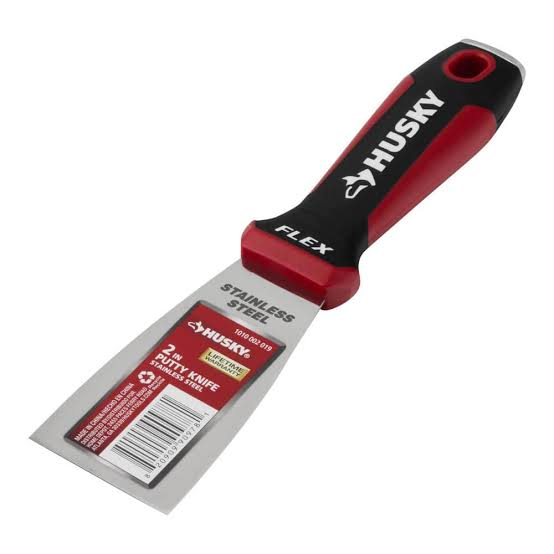
Price: ~$8–$12 | Blade Width: 2 in | Blade Length: 3.5 in | Material: Stainless steel
The Short Review
This is the putty knife that made us stop searching. In our head-to-head testing against five top competitors, the Husky separated itself immediately with one feature that sounds simple but changes everything: the handle.
It’s beefier than most putty knife handles, with a secure rubberized grip that conforms to your hand. Where other knives felt too small or slippery, this one gave us a feeling of control and leverage when bearing down to scrape old paint. That ergonomic advantage isn’t a luxury—it’s the difference between a quick job and hand cramps.
The stainless steel blade is thicker and stiffer than competitors, making it especially effective as a scraper. It powered through our paint scraping test without any noticeable wear or edge degradation. While the blade lacks the extreme flexibility of dedicated drywall knives, it wasn’t so stiff that applying spackle over nail holes felt difficult. It struck the perfect balance for a homeowner who needs one knife that does everything.
Build quality feels like a higher-end product than the price suggests. The combination of a substantial handle and durable blade gives this knife a longevity that cheap alternatives simply can’t match.
Buy this if: You want one putty knife that handles spackling, scraping, and general home repairs with comfort and durability.
Skip this if: You need extreme blade flexibility for professional drywall finishing, or you specifically want a multi-tool with built-in can openers and nail pullers.
Pros
- Comfortable ergonomic handle with rubber grip—best in our tests
- High-quality stainless steel blade resists corrosion
- Thicker blade excels at scraping without excessive flex
- Lightweight and well-balanced feel
- Excellent value—performs above its price point
- Durable enough for years of home projects
Cons
- Blade could lack the flexibility for professional drywall mudding
- No multi-tool features (can opener, nail puller, etc.)
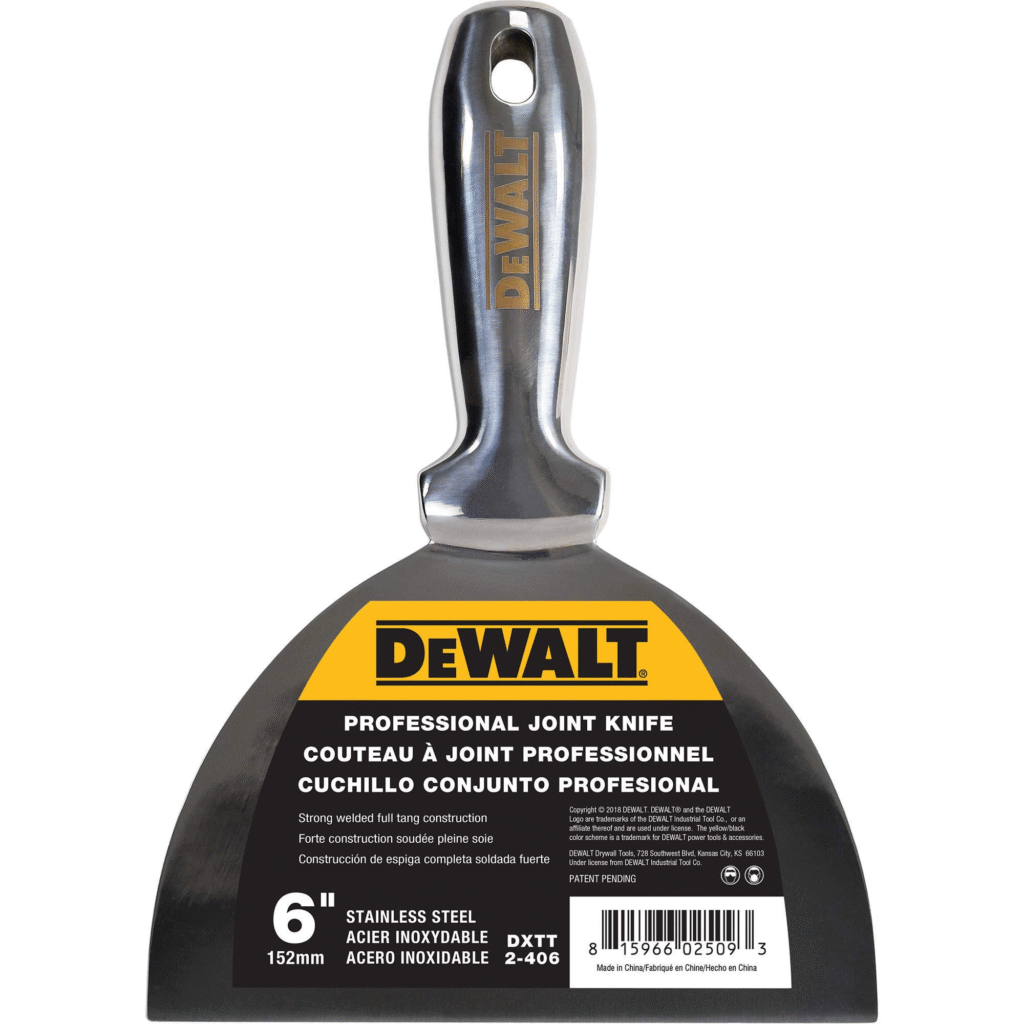
2. DeWalt 6-Inch Stainless Steel Putty Knife — Best Putty Knife for Heavy Scraping
Price: ~$15–$20 | Blade Width: 6 in | Blade Length: ~4 in | Material: Stainless steel
The Short Review
When the job is less about delicate spackling and more about stripping layers of old paint or removing stubborn wallpaper, you need a wider, sturdier blade. The DeWalt 6-inch putty knife delivers exactly that.
The extra width spreads pressure across a larger surface, making it easier to scrape large areas without gouging the wall underneath. The stainless steel blade holds its edge through aggressive use, and the full-tang construction—where the blade extends all the way through the handle—eliminates the wobble and flex that plague cheaper wide knives.
The handle is overmolded rubber with DeWalt’s signature ergonomic shaping. Even during extended scraping sessions, hand fatigue was minimal. The hammer end on the handle is a practical bonus for seating nails or closing paint cans.
In our testing, this knife handled everything from peeling latex paint to scraping dried wallpaper adhesive without the blade chipping or rolling. The 6-inch width also makes it useful for applying and smoothing larger patches of joint compound when you don’t need the feathering precision of a dedicated taping knife.
Buy this if: You’re stripping paint or wallpaper, repairing large wall areas, or need a wide, rigid scraper that won’t flex under pressure.
Skip this if: You primarily do detail work, small nail-hole patches, or need a compact knife for tight spaces.
Pros
- Extra-wide 6-inch blade covers large areas efficiently
- Full-tang stainless steel construction for maximum durability
- Overmolded rubber handle reduces fatigue
- Hammer end for nails and paint cans
- Excellent edge retention through heavy scraping
- Rigid blade prevents wall gouging
Cons
- Too wide for small detail work and tight corners
- Heavier than smaller putty knives
- Less flexible than blades designed for feathering compound
3. Purdy 14A900210 Surface Prep Painters Tool — Best Multi-Tool Putty Knife
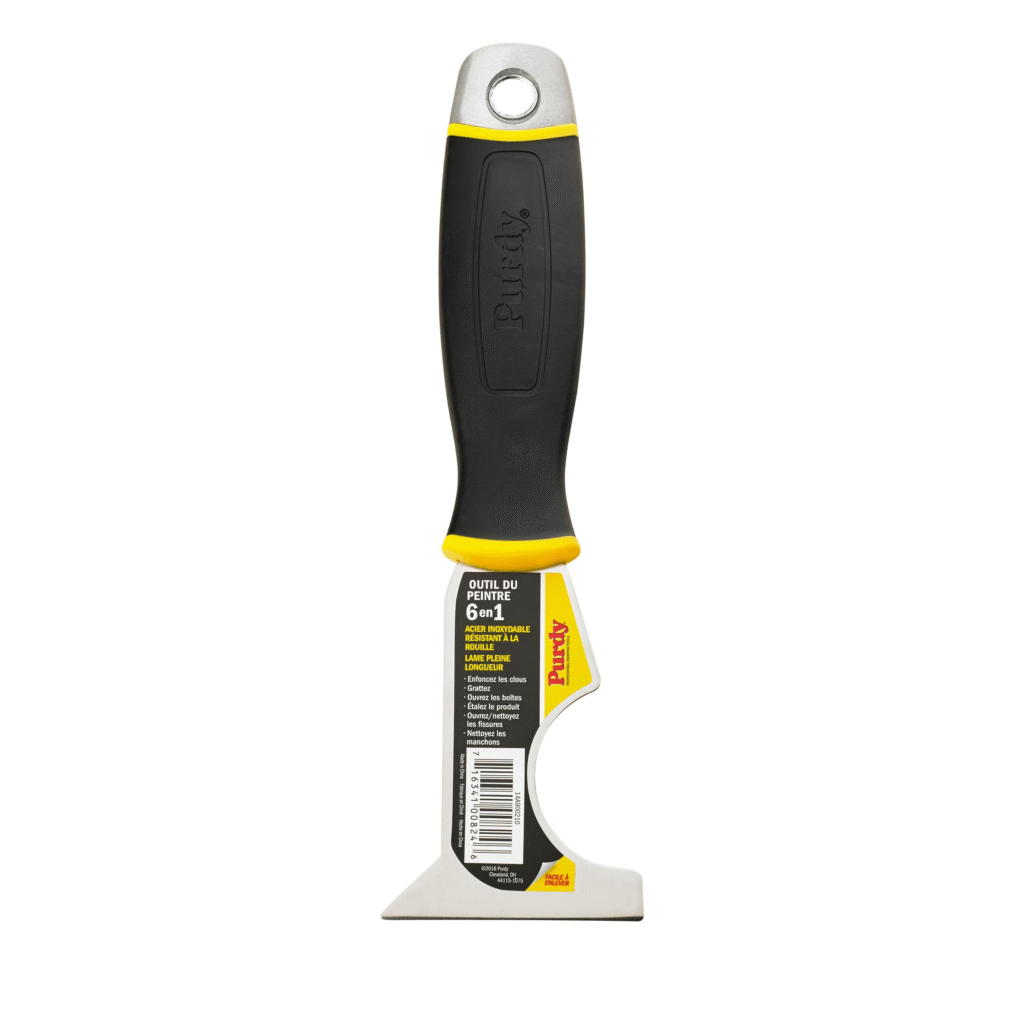
Price: ~$12–$15 | Blade Width: 2.5 in | Material: Stainless steel
The Short Review
Why carry five tools when one does the job? The Purdy Surface Prep Painters Tool is the Swiss Army knife of putty knives—a scraper, spreader, roller cleaner, can opener, nail puller, and hammer all in one compact tool.
The curved side is specifically designed for cleaning paint out of rollers, a task that usually requires a separate tool or your fingers. The built-in can opener pops paint lids without bending them, and the nail puller at the handle end extracts fasteners without digging into the wall. The hammer face lets you pound paint cans closed or seat small nails.
Despite all these features, the blade itself doesn’t feel compromised. It’s stiff enough for scraping, flexible enough for spreading, and the edge holds up through mixed use. The handle is comfortable and well-shaped, though not as ergonomically refined as the Husky.
In our testing, this tool became the go-to for quick jobs where we didn’t want to haul out the full toolbox. Hanging a picture? Open the paint, fill the hole, smooth the spackle, clean the brush, close the can—one tool, done.
The trade-off is specialization. For professional drywall finishing or heavy scraping, dedicated tools perform better. But for 90% of home painting prep, this is the only tool you need in your back pocket.
Buy this if: You want maximum versatility in one tool, do frequent painting prep work, or need a compact multi-tool for quick home repairs.
Skip this if: You need professional-grade performance for dedicated drywall work, or prefer separate specialized tools.
Pros
- Multi-function design replaces several separate tools
- Curved edge cleans paint rollers effectively
- Built-in can opener and nail puller
- Hammer end for closing paint cans
- Stainless steel blade resists corrosion
- Compact and easy to carry
Cons
- Jack-of-all-trades means master of none
- Handle ergonomics not as refined as dedicated putty knives
- Blade width limits use for large-area smoothing
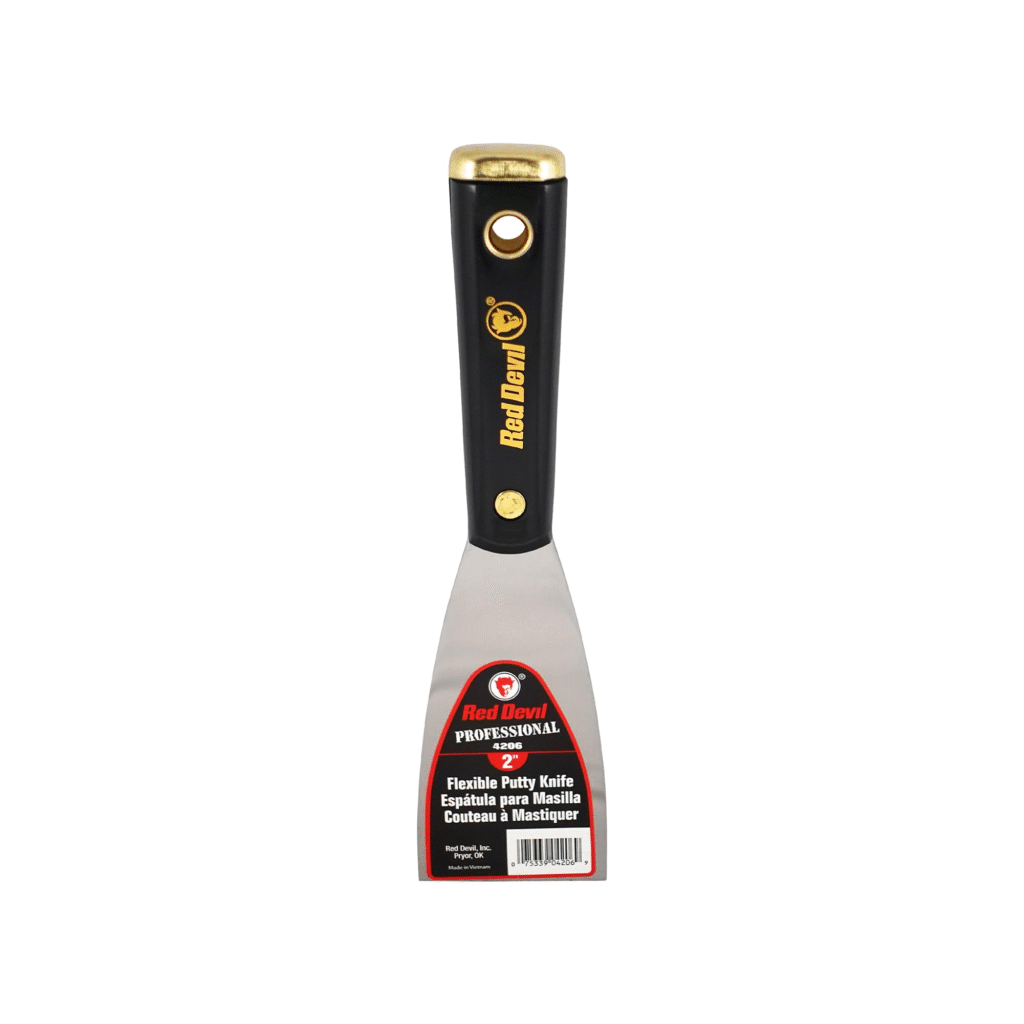
4. Red Devil 4206 2-Inch Flex Putty Knife — Best Flexible Putty Knife for Smooth Finishes
Price: ~$6–$8 | Blade Width: 2 in | Material: Carbon steel
The Short Review
Sometimes you need a blade that bends. When feathering joint compound over drywall seams or applying spackle to curved surfaces, a stiff blade leaves ridges and lines that require sanding. The Red Devil 4206 Flex delivers the flexibility that creates truly smooth finishes.
In our testing, this knife laid down the most even coat of spackle over nail holes and divots. The blade flexed just enough to conform to wall contours while maintaining enough rigidity to push compound where we wanted it. The result: less sanding, faster prep, and a more professional-looking paint job.
The carbon steel blade is thinner and more flexible than stainless alternatives, but it requires more care. Wipe it clean after use and store it dry, or surface rust will develop. For occasional home use, this is a minor inconvenience. For professionals working daily, the maintenance adds up.
The handle is basic plastic—functional but not comfortable for extended sessions. At this price, though, the blade performance more than compensates. This is the knife you reach for when the finish quality matters more than the scraping power.
Buy this if: You need a flexible blade for feathering joint compound, smoothing spackle, or working on curved surfaces.
Skip this if: You need a scraper for paint removal, or you want a low-maintenance stainless steel blade.
Pros
- Superior flexibility for smooth, even compound application
- Excellent for feathering drywall mud and spackle
- Very affordable
- Thin blade conforms to surface contours
- Reduces sanding time with better initial finish
Cons
- Carbon steel requires maintenance to prevent rust
- Plastic handle is less comfortable than rubberized grips
- Too flexible for effective scraping
- Not as durable as stainless steel alternatives
5. Project Source DIY Flex 2-Inch Steel Putty Knife — Best Budget Putty Knife
Price: ~$4–$6 | Blade Width: 2 in | Material: Steel
The Short Review
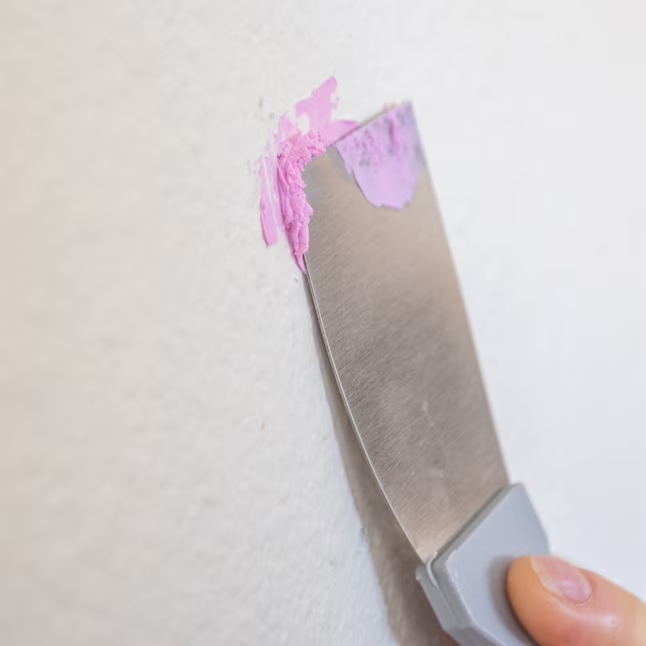
At roughly half the price of our top pick, the Project Source DIY Flex shouldn’t perform this well—but it does. This is the putty knife we recommend when someone says, “I just need something for occasional use that actually works.”
The blade offers genuine flexibility for spreading spackle and joint compound. In our tests, it laid down smooth coats over nail holes and small drywall repairs. The edge held up through moderate scraping, though it dulled faster than premium stainless steel blades.
The handle is basic but functional. It’s not as comfortable as the Husky’s rubberized grip, but it doesn’t create hot spots or slip during normal use. For a tool you’ll use a few times a year, it’s perfectly adequate.
The real story is value. This knife handles 80% of home putty knife tasks at 40% of the cost. Yes, it will eventually rust if neglected. Yes, the edge will dull with heavy use. But for hanging a few pictures, patching a rental before move-out, or occasional touch-ups, it’s genuinely capable.
Buy this if: Your budget is under $10, you need a putty knife for occasional home projects, or you want a disposable option for messy jobs.
Skip this if: You measure frequently, need maximum durability, or want professional-grade finish quality.
Pros
- Excellent value—performs well at a budget price
- Genuine blade flexibility for smooth spreading
- Lightweight and easy to control
- Widely available at major retailers
- Perfect for occasional DIYers
Cons
- Steel blade requires maintenance to prevent rust
- Edge dulls faster than premium stainless steel
- Basic handle lacks ergonomic refinement
- Not built for heavy or professional use
6. ROLLINGDOG 14 cm Stainless Steel Taping Knife — Best Putty Knife for Drywall Taping
Price: ~$18–$22 | Blade Width: 5.5 in (14 cm) | Material: 420-grade stainless steel
The Short Review
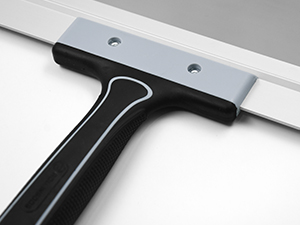
Taping drywall joints requires a different tool than filling nail holes. You need a wider blade, a flatter profile, and a polished surface that glides through joint compound without dragging or leaving marks. The ROLLINGDOG 14 cm taping knife delivers exactly that.
The 420-grade stainless steel blade is polished to a mirror finish that resists corrosion and minimizes friction against wet compound. In our testing, it applied and feathered joint compound more smoothly than standard putty knives, creating seams that needed minimal sanding before painting.
The blade is specifically designed for taping—wider and flatter than a putty knife, with just enough flexibility to bed tape firmly without tearing it. The ergonomic rubberized handle provides the control needed for long, straight strokes across wall seams.
This is a specialized tool. For small spackle jobs or scraping, a standard putty knife is more practical. But for anyone finishing drywall—whether a basement renovation or a patch repair—this knife makes the difference between a lumpy wall and a professional result.
Buy this if: You’re taping drywall seams, finishing large patches, or need a dedicated tool for smooth joint compound application.
Skip this if: You only do small spackle repairs, or you need a versatile tool for scraping and multi-purpose use.
Pros
- Polished 420-grade stainless steel blade glides smoothly
- Optimal width for bedding and feathering tape
- Corrosion-resistant even with frequent water contact
- Ergonomic handle for precise control
- Creates professional-quality finishes with less sanding
Cons
- Specialized for taping—not versatile for scraping
- Higher price than basic putty knives
- Wider blade limits use in tight spaces
7. ROLLINGDOG 3-Piece Stainless Steel Putty Knife Set — Best Putty Knife Set for Homeowners
Price: ~$25–$30 | Blade Widths: 2 in, 4 in, 6 in | Material: 420-grade stainless steel
The Short Review
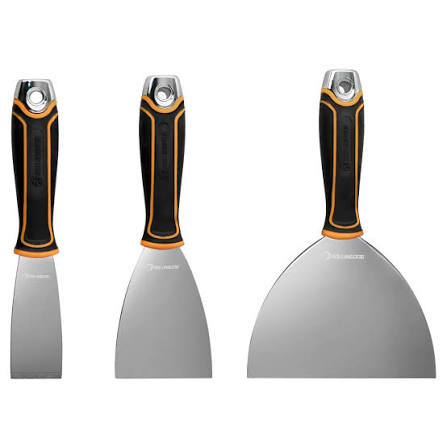
Most homeowners don’t know which size putty knife they need until they’re mid-project and realize the 2-inch blade is too small for the drywall patch, or the 6-inch blade is too wide for the nail hole. This three-piece set solves that problem permanently.
The set includes 2-inch, 4-inch, and 6-inch blades—all made from hollow-ground 420-grade stainless steel that flexes appropriately for each size. The 2-inch handles detail work and small repairs. The 4-inch covers medium patches and general spreading. The 6-inch tackles large areas and scraping.
Each knife features a robust metal hammer-end on the handle, adding functionality for drywall work and paint can management. The rubberized grips reduce hand fatigue across all three sizes.
In our testing, having the right size for each job made work faster and results better. No more trying to feather a large patch with a tiny blade, or gouging a small repair with an oversized knife. The blades held their edges through multiple projects, and the stainless steel construction resisted corrosion even when we forgot to wipe them down.
Buy this if: You want a complete set for any home project, do varied repair and painting work, or want the right tool for every job size.
Skip this if: You only need one size for a specific task, or you’re on a strict single-tool budget.
Pros
- Three essential sizes cover every common home application
- Hollow-ground 420-grade stainless steel blades
- Hammer-end handles add versatility
- Rubberized grips for comfort
- Corrosion-resistant for low maintenance
- Better value than buying knives individually
Cons
- Higher upfront cost than a single knife
- Includes sizes you may rarely use
- Takes more storage space than one tool
8. ROLLINGDOG 60 cm Skimming Blade — Best Putty Knife for Large Surface Skimming
Price: ~$45–$55 | Blade Width: 23.6 in (60 cm) | Material: #201 stainless steel (replaceable)
The Short Review
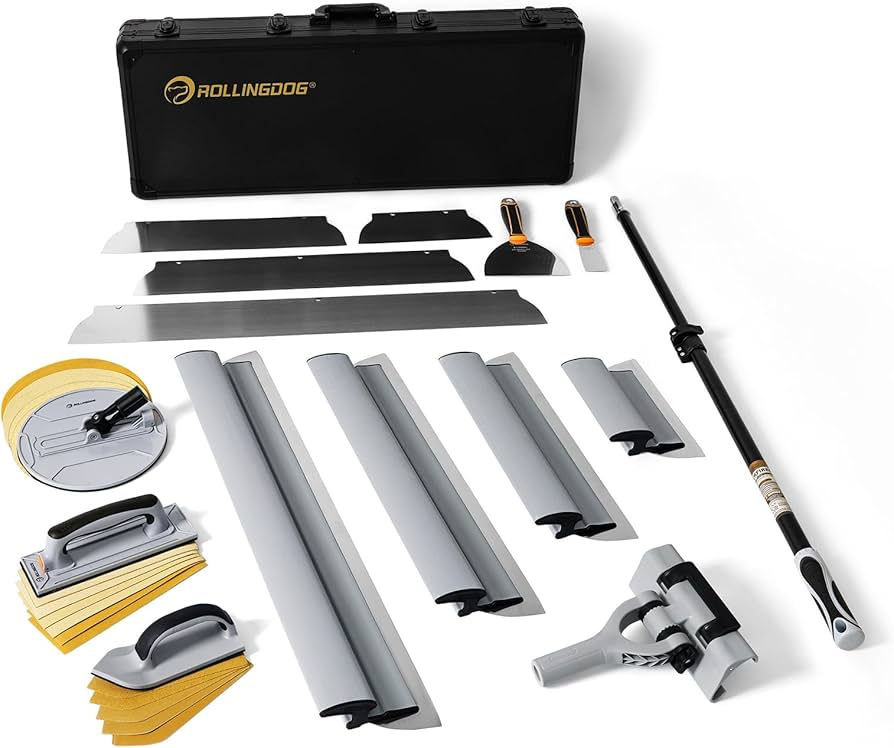
When you’re skimming an entire wall or ceiling with joint compound, a standard putty knife is like painting a house with a toothbrush. The ROLLINGDOG 60 cm skimming blade covers massive areas in single strokes, turning hours of work into minutes.
The 60-centimeter width lets you apply and smooth compound across wide swaths with minimal overlap marks. The replaceable #201 stainless steel blade means when the edge eventually dulls, you swap the blade instead of buying a whole new tool—significant savings for frequent users.
The PVC handle is lightweight and balanced despite the blade’s size. Extension pole compatibility lets you work on ceilings and high walls without a ladder, saving time and reducing fatigue.
This is not a tool for small repairs. It’s overkill for nail holes and touch-ups. But for whole-room renovations, new drywall finishing, or plaster work, it’s transformative. One tester described it as “the difference between sanding for a day and sanding for an hour.”
Buy this if: You’re skimming large walls or ceilings, doing professional drywall work, or want to minimize sanding time on big projects.
Skip this if: You only do small repairs, or you don’t have the storage space for a 2-foot blade.
Pros
- Massive 60 cm width covers large areas rapidly
- Replaceable blade reduces long-term costs
- Extension pole compatible for ceilings and high walls
- Lightweight PVC handle balances the large blade
- Dramatically reduces application and sanding time
Cons
- Overkill for small repairs and detail work
- Requires significant storage space
- Higher upfront investment
- Needs some practice for even results
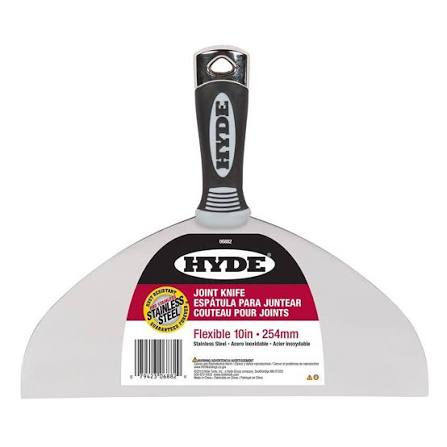
9. Hyde Tools Pro Putty Knife — Best Professional-Grade Putty Knife
Price: ~$10–$14 | Blade Width: 1.5–3 in (various) | Material: Stainless steel
The Short Review
Hyde Tools has been making putty knives since 1875, and that longevity shows in the details. This is the knife that professional painters and drywallers reach for when they need reliability they can trust day after day.
The stainless steel blade is tempered and polished to a precise flexibility that Hyde has refined over nearly 150 years. It’s stiff enough for scraping, flexible enough for spreading, and the edge holds through job after job. The rust-resistant finish means even with constant exposure to wet compound, the blade stays smooth and functional.
The handle is a classic hardwood design that some pros prefer over rubberized grips—it doesn’t get slippery when wet, and it lasts longer than plastic alternatives. The brass rivets securing the blade are solid and traditional, creating a tool that feels like it could be passed down.
In our testing, the Hyde performed consistently across spackling, scraping, and cleaning tasks. It didn’t excel in any single category the way specialized tools do, but it refused to fail in any category either. That’s the hallmark of a professional tool: not flashy, just reliable.
Buy this if: You value traditional craftsmanship, want a tool that lasts decades, or prefer a hardwood handle over rubberized grips.
Skip this if: You want the most ergonomic modern handle, or you need extreme flexibility for specialized finishing work.
Pros
- Nearly 150 years of proven craftsmanship
- Tempered stainless steel blade with excellent edge retention
- Classic hardwood handle that lasts longer than plastic
- Rust-resistant finish for wet compound work
- Reliable, consistent performance across all tasks
- Brass rivet construction for durability
Cons
- Hardwood handle less comfortable than rubberized grips for some users
- Not as specialized as modern ergonomic designs
- Slightly higher price than basic alternatives
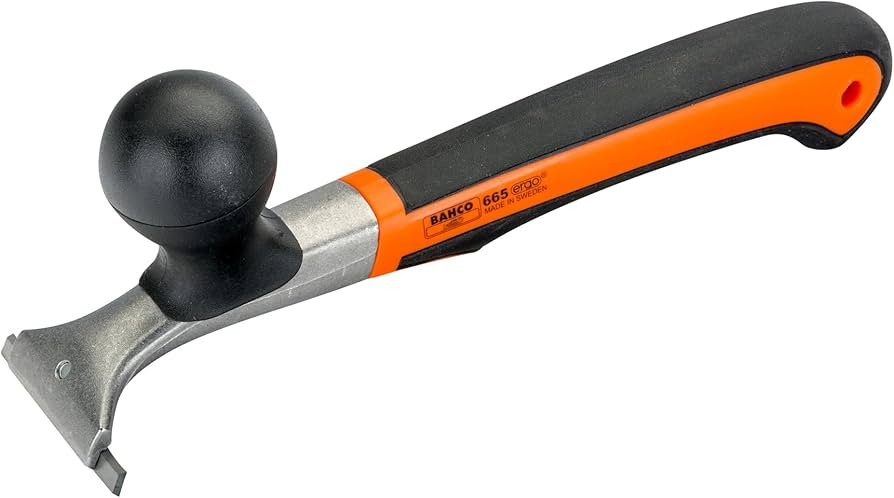
10. Bahco Ergonomic Scraper with Replaceable Blade — Best Putty Knife for Detail and Precision Work
Price: ~$20–$25 | Blade Width: 2 in | Material: Carbon steel (replaceable)
The Short Review
Sometimes the job isn’t about power or width—it’s about control. The Bahco Ergonomic Scraper is built for precision: cleaning edges, scraping in tight corners, removing caulk, and any task where a standard putty knife feels clumsy and oversized.
The ergonomic handle is sculpted to fit the hand naturally, with a two-component grip that provides tactile feedback and slip resistance even with wet or gloved hands. The replaceable blade system means you always have a sharp edge—critical for clean scraping and fine detail work.
In our testing, this tool excelled at tasks that frustrated standard putty knives: removing old caulk from window frames, scraping paint from molding without damaging the wood underneath, and cleaning adhesive residue from tight corners. The blade angle and handle geometry give you leverage and control that flat-bladed knives simply can’t match.
The carbon steel blade is sharper than stainless alternatives but requires more maintenance. The replaceable system justifies the higher price—when the edge dulls, a new blade costs a few dollars instead of replacing the whole tool.
Buy this if: You do precision scraping, caulk removal, detail work, or want a sharp, replaceable blade system.
Skip this if: You need a flexible blade for spreading compound, or you want a low-maintenance stainless steel tool.
Pros
- Ergonomic two-component handle for maximum control
- Replaceable blade system keeps edge sharp indefinitely
- Excellent for precision scraping and detail work
- Superior leverage for caulk and adhesive removal
- Carbon steel blade holds a sharper edge than stainless
Cons
- Carbon steel requires maintenance to prevent rust
- Higher price due to replaceable blade system
- Not suitable for spreading joint compound or spackle
- Specialized for scraping rather than general use
Complete Buying Guide: How to Choose the Right Putty Knife
Blade Material: What Actually Matters
Stainless Steel
The best choice for most homeowners. Resists rust, holds its edge well, and handles both spreading and scraping. Slightly less flexible than carbon steel, but the durability trade-off is worth it for occasional use. All our top picks use stainless steel for good reason.
Carbon Steel
Holds a sharper edge and offers more flexibility for smooth finishing. However, it rusts quickly if not cleaned and dried after each use. Best for professionals who maintain their tools religiously, or for dedicated finishing knives that stay indoors.
Plastic
Disposable and inexpensive. Fine for spreading spackle on small nail holes, but lacks the rigidity for scraping and the precision for professional finishing. Skip these unless you’re doing a one-time job and don’t want to clean up.
Blade Size: Matching the Tool to the Job
1 to 2 inches: Detail work, nail holes, small cracks, tight corners, and cleaning paint rollers. The most versatile size for general home use.
3 to 4 inches: Medium drywall patches, general spreading, and scraping larger areas. A good middle ground when you need more coverage than a 2-inch blade provides.
5 to 6 inches: Large patches, heavy scraping, wallpaper removal, and applying joint compound over broad areas. Rigid blades in this size excel at stripping tasks.
8+ inches: Professional drywall finishing, taping seams, and skimming large surfaces. These are specialized tools, not general-purpose putty knives.
Flexibility: Stiff vs. Flexible Blades
Stiff Blades
Better for scraping paint, removing wallpaper, and applying pressure over large areas. The Husky and DeWalt excel here. Too stiff, though, and the blade skips over surface contours instead of conforming to them.
Flexible Blades
Better for feathering joint compound, smoothing spackle, and creating glass-smooth finishes. The Red Devil Flex and ROLLINGDOG taping knife demonstrate this perfectly. Too flexible, and the blade can’t push compound where you want it.
The Sweet Spot
Most homeowners need a blade with moderate flexibility—stiff enough for scraping, flexible enough for smoothing. The Husky 2-inch hits this balance better than any knife we tested.
Handle Design: Comfort Equals Control
Rubberized Overmolded Grips
Best for extended use and wet conditions. The Husky and DeWalt handles reduce hand fatigue and prevent slipping. These are the most comfortable options for homeowners.
Hardwood Handles
Traditional, durable, and preferred by many professionals. The Hyde Tools Pro uses this classic design. They last longer than plastic but can be less comfortable for long sessions.
Plastic Handles
Lightweight and inexpensive. Fine for occasional use but can create pressure points and slip when wet. Common on budget knives like the Project Source.
Ergonomic Sculpted Grips
Designed for specific hand positions and maximum control. The Bahco scraper uses this approach for precision work. Excellent for specialized tasks but not necessary for general home use.
What We Learned After Testing 10+ Putty Knives
The handle matters more than the blade. A sharp blade with a poor handle creates a frustrating tool. A good blade with a great handle creates a tool you reach for first. The Husky won our top spot primarily because of its ergonomic advantage.
Stiffness is situational. There’s no “best” flexibility—only the right flexibility for your most common tasks. Most homeowners should prioritize moderate stiffness for versatility.
Edge quality degrades predictably. Stainless steel edges dull gradually and evenly. Carbon steel chips and rolls if abused. Plastic edges deform immediately. Plan to replace or sharpen budget knives; invest in quality for longevity.
Multi-tools sacrifice specialization. The Purdy Painters Tool is incredibly convenient but won’t outperform dedicated tools at any single task. It’s the right choice for convenience, not for peak performance.
Price Ranges — What to Expect
Budget ($4–$8): Basic steel or plastic knives for occasional use. Expect to replace them every few projects. Examples: Project Source DIY Flex, basic hardware store brands.
Mid-Range ($8–$18): The sweet spot for most homeowners. Stainless steel blades, comfortable handles, and genuine durability. Examples: Husky 2-inch, Red Devil Flex, Hyde Tools Pro.
Premium ($18–$30): Specialized tools with advanced features, replaceable blades, or professional-grade materials. Examples: ROLLINGDOG taping knife, Bahco ergonomic scraper.
Specialty ($30–$55): Large skimming blades and professional sets. Overkill for most homeowners but transformative for large projects. Example: ROLLINGDOG 60 cm skimming blade.
Final Tips Before You Buy
Buy two knives, not one. A 2-inch knife for detail work and a 4–6 inch knife for larger tasks covers 95% of home projects. The 3-piece set is ideal if your budget allows.
Feel the handle before you buy. Grip the knife and mimic spreading and scraping motions. If it feels awkward now, it’ll feel worse after an hour of use.
Check the blade edge. Run your finger lightly along the edge (carefully). It should feel consistently sharp, not rolled or chipped. Even budget knives should have a clean edge out of the package.
Consider your most common task. If you paint and patch walls, prioritize flexibility. If you renovate and strip surfaces, prioritize stiffness. Match the tool to your reality, not your aspirations.
Store it properly. Wipe the blade clean after use, especially with carbon steel. Hang it or store it flat—don’t toss it in a toolbox where the edge gets nicked by hammers and screwdrivers.
Frequently Asked Questions
Q: What’s the difference between a putty knife and a spackle knife?
A: Nothing—they’re the same tool. “Putty knife” is the traditional name, while “spackle knife” became common as spackle replaced putty for wall repairs. Some pros distinguish between stiff putty knives (for scraping) and flexible spackle knives (for spreading), but the terms are interchangeable for homeowners.
Q: Can I use a putty knife for drywall mudding?
A: Yes, for small patches and nail holes. For taping seams and finishing large areas, use a dedicated taping knife (5+ inches wide) or skimming blade. A standard putty knife is too narrow and often too stiff for professional drywall finishing.
Q: How do I clean a putty knife?
A: Wipe wet compound off immediately with a damp cloth. For dried material, soak the blade in warm water for 10 minutes, then scrape gently with a plastic scraper. Never use abrasive pads on stainless steel—they scratch the finish and promote rust. Dry thoroughly after cleaning, especially with carbon steel blades.
Q: Can I sharpen a putty knife?
A: Yes, with a mill file or fine sharpening stone. Hold the blade at its original bevel angle (usually about 90 degrees for scrapers, slightly less for flexible knives) and file in one direction. Stainless steel takes more effort than carbon steel. If the edge is chipped or heavily rolled, replacement is usually better than sharpening.
Q: Why does my putty knife leave ridges when I spread spackle?
A: Your blade is likely too stiff or you’re using too much pressure. Switch to a more flexible blade for finishing work, and use lighter, smoother strokes. Let the blade do the work—don’t force it. Applying compound in thin layers also reduces ridges.
Q: What’s the best putty knife for removing wallpaper?
A: A wide (4–6 inch), stiff blade with a sharp edge. The DeWalt 6-inch excels here. Score the wallpaper first with a scoring tool, apply warm water or remover solution, then scrape at a low angle to avoid gouging the wall underneath.
Q: Should I buy a plastic putty knife?
A: Only for very small, one-time jobs where you don’t want to clean up afterward. Plastic blades lack the rigidity for scraping and the precision for quality finishing. For anything more than filling a single nail hole, invest in stainless steel.
Q: How long should a quality putty knife last?
A: With proper care, a stainless steel putty knife lasts 5–10 years or longer. Carbon steel knives last similarly if maintained but rust faster if neglected. Budget steel knives may need replacement every 1–2 years with regular use. The handle usually fails before the blade on quality knives.
Q: What’s the best putty knife for a beginner?
A: The Husky 2-inch Stainless Steel. It’s versatile enough for most tasks, comfortable to hold, durable enough to forgive mistakes, and inexpensive enough that you won’t regret the purchase if you rarely use it. Start here, then add sizes as your projects demand.
Q: Can I use a putty knife to open paint cans?
A: Yes, but it’s not ideal. The blade edge can chip against the metal lid, and paint residue on the knife contaminates your compound. Use a dedicated can opener or the built-in opener on a multi-tool like the Purdy Painters Tool. If you must use a putty knife, use an older one you don’t mind damaging.
Disclosure: We independently research and test products. When you buy through links on our site, we may earn an affiliate commission at no extra cost to you.