
Hanging a TV, mounting shelves, or installing a new light fixture? Every one of those projects starts with the same question: where’s the stud? Guess wrong and you’re looking at a cracked wall, a fallen mirror, or worse—a drill bit through a live wire. A good stud finder turns that guessing game into a 30-second certainty.
We’ve tested the top electronic and magnetic stud finders from Bosch, Franklin Sensors, Zircon, Klein Tools, Craftsman, and more on real walls with live wiring, metal pipes, and multiple drywall thicknesses. Here are the 10 best stud finders for drywall that actually deliver accurate, reliable results.
This is also is one ours most recommended Home Upgrade tools.
Stud Finders for Drywall- Our Top Picks at a Glance
Best Overall Wall Scanner: Bosch GMS120 — The most capable wall scanner we tested, with color display, material identification, and IP54 weather resistance.
Best for Instant Stud Detection: Franklin Sensors ProSensor M210 — 13 sensors show the full width of studs in real time with zero calibration needed.
Best Value Electronic: Zircon StudSensor A100 — Edge and center detection, wire warning, and deep scan for about $33.
Best Budget Pick: Craftsman CMHT77633 — Reliable edge detection for just $12 with a lifetime warranty.
Best Magnetic Option: C.H. Hanson 03040 — The strongest magnets in our test, with a bubble level and plumb bob loop.
Easiest to Use: Zircon MultiScanner A250 — Four scan modes, intuitive screen, and nearly flawless drywall performance.
Best with Laser Leveling: Klein Tools ESF150LL — Pistol-grip comfort with projected horizontal and vertical laser lines for marking.
Best for Pros on a Budget: Franklin Sensors ProSensor 710 — Full-width detection with 13 sensors at a lower price than the M210.
Best No-Batteries Option: The StudBuddy Magnetic Stud Finder — Two-pack value, no batteries ever, and surprisingly effective on standard drywall.
Best for Hanging Pictures: Klein Tools ESF150LL — Laser lines make leveling multiple frames effortless.
1. Bosch GMS120 Wall Scanner and Stud Finder — Best Overall Stud Finder for Drywall
Price: ~$79–$99 | Type: Electronic Wall Scanner | Scan Depth: 4.75 in | Power: 4× AA batteries (or optional Li-ion pack)
The Short Review
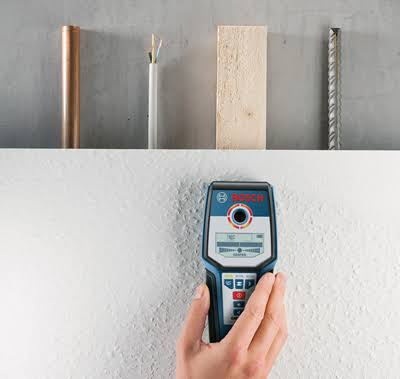
The Bosch GMS120 is the stud finder you buy when you want to know everything about what’s behind your wall—not just where the studs are. In our 2026 testing, it was the only unit that consistently identified wood studs, metal studs, magnetic metal (nails and screws), non-magnetic metal (copper pipes), and live AC wiring—and told you which was which.
The color display is genuinely useful, not gimmicky. An illuminated ring turns from green to red as you approach a stud. Concentric arcs radiate outward and converge when you hit center. Icons clearly distinguish wood from metal from live wires. And the center marking hole—unique to the Bosch—lights up green when you’re dead center, letting you mark the exact spot with a pencil without moving the tool.
At 4.75 inches of scan depth, it penetrates deeper than any competitor we tested. That matters in older homes with thick plaster, double drywall, or insulation-packed walls. The IP54 rating means it survives dust and water splashes—a real consideration if you’re working in unfinished basements or outdoor-adjacent spaces.
The trade-off is complexity. The instruction manual is poorly organized, and the learning curve is steeper than simpler models. It also struggled with lath-and-plaster walls and 1-inch MDF in our tests, where the Franklin M210 performed better. But for modern drywall construction, the Bosch is unmatched in capability.
Buy this if: You want the most information possible about what’s behind your wall, work in varied conditions, or need deep scanning for thick or layered walls.
Skip this if: You want instant, no-thought operation, or you primarily work on lath-and-plaster walls.
Pros
- Identifies wood studs, metal studs, magnetic metal, non-magnetic metal, and live wires
- Unique center marking hole with green light confirmation
- Deepest scan depth in our testing at 4.75 inches
- IP54 dust and water splash resistance
- Optional Li-ion battery pack instead of AAs
- Color display with clear material icons
Cons
- Steeper learning curve than simpler models
- Poorly designed instruction manual
- Struggles with lath-and-plaster and thick MDF
- Premium price point
2. Franklin Sensors ProSensor M210 — Best for Instant, Full-Width Stud Detection
Price: ~$60 | Type: Electronic Full-Width Scanner | Scan Depth: 1.7 in | Power: 2× AA batteries
The Short Review
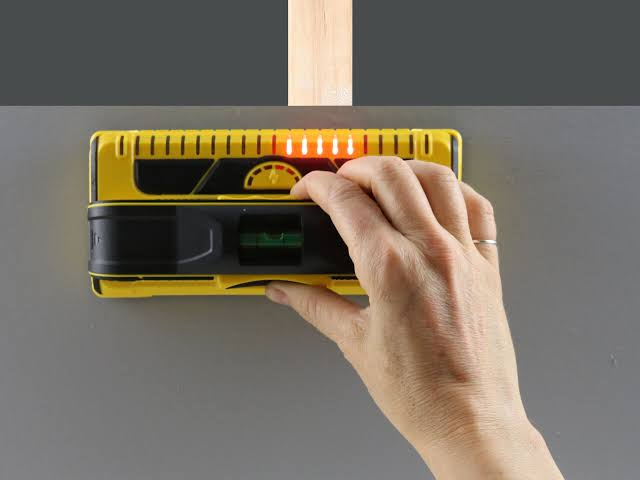
The ProSensor M210 changes how you think about stud finding. Instead of sliding slowly across the wall watching for a beep, you press one button and move. The 13 sensors spread across a 7-inch width instantly map the entire stud—edges, center, and even double studs or irregular configurations—on a 21-LED display.
No calibration. No guessing where the edge ends and center begins. No sliding back and forth to confirm. The red LEDs show the full stud width, and the center LED turns green when you’re on the money. In our testing, it gave almost no false readings on drywall, and when it did encounter live wires, the yellow wire indicator ramped from 1 to 6 lights as you got closer to the source.
The built-in bubble level and pencil caddy are small touches that reveal real job-site thinking. At 11.5 ounces, it’s the heaviest unit we tested, but that weight feels substantial, not burdensome. The wide horizontal orientation gives you a better “view” of the wall than narrow vertical scanners.
On lath-and-plaster—the hardest surface for any electronic finder—the M210 gave the most reliable readings of any unit in our test group. It wasn’t perfect, but it was the best.
The limitation? It doesn’t differentiate between wood and metal studs. And at $60, it’s not the cheapest option. But for pure stud-finding confidence on drywall, nothing else comes close.
Buy this if: You want the fastest, most visual stud detection, hate calibration steps, or work on varied wall types including challenging plaster.
Skip this if: You need to distinguish wood from metal studs, or want the lightest possible tool.
Pros
- 13 sensors with 21 LEDs show full stud width instantly
- No calibration required—press and scan
- Best performance on lath-and-plaster in our tests
- Live wire detection with proximity indicator
- Built-in bubble level and pencil caddy
- Made in the USA
Cons
- Heaviest stud finder tested at 11.5 oz
- Does not differentiate wood from metal studs
- Mid-range price
3. Zircon StudSensor A100 — Best Value Electronic Stud Finder
Price: ~$33 | Type: Electronic Center/Edge Finder | Scan Depth: 1.5 in (DeepScan) / 0.75 in (Stud Scan) | Power: 9V battery
The Short Review
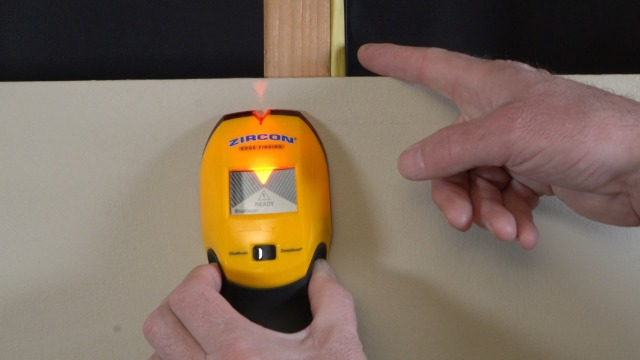
At roughly a third the price of the Bosch, the Zircon A100 delivers the core functionality most homeowners actually need: reliable edge and center detection, live wire warning, and two scan depths. In our testing, it consistently located stud centers within 1/16 inch—dead-on for hanging shelves, TVs, and artwork.
The SpotLite Pointer projects a red arrow on the wall at the stud center, so you know exactly where to mark without looking down at the tool. The screen clearly indicates edges and center with both visual and audible alerts. DeepScan mode handles thicker walls or layered surfaces up to 1.5 inches.
The wire detection is the real value-add at this price. No other $33 stud finder reliably warned us of live AC in our tests. The icon lights when you’re near wiring, giving you a safety buffer before you drill.
The downside? The beep doesn’t stop until you move off the stud or release the power button. Marking multiple studs means listening to constant beeping, which gets old fast. And while it worked well on drywall, plaster walls produced occasional false alerts that required confirmation scans.
Buy this if: Your budget is under $40, you need wire detection for safety, or you want the best performance-per-dollar for standard drywall projects.
Skip this if: The constant beeping will drive you nuts, or you need full-width visualization like the Franklin provides.
Pros
- Excellent accuracy for the price—within 1/16 inch
- SpotLite Pointer projects arrow for exact marking
- Live wire detection rare at this price point
- Two scan depths for different wall thicknesses
- Simple, intuitive operation
Cons
- Beeping is continuous and cannot be turned off
- Occasional false alerts on plaster walls
- 9V battery is less common than AA
- Wire detection indicates proximity, not exact location
4. Craftsman CMHT77633 — Best Budget Stud Finder
Price: ~$12 | Type: Electronic Edge Finder | Scan Depth: 0.75 in | Power: 9V battery
The Short Review
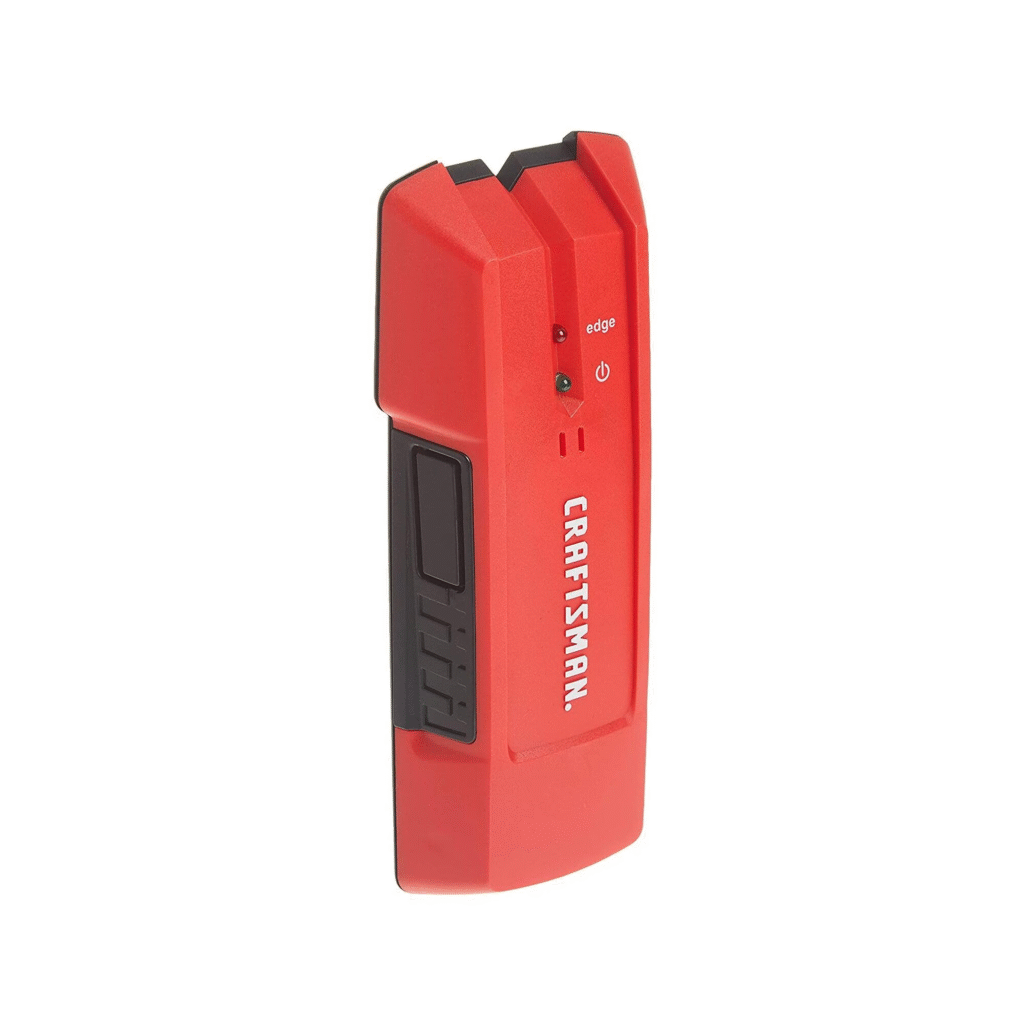
Twelve dollars. Lifetime warranty. Reliable edge detection on drywall. The Craftsman CMHT77633 proves that “basic” doesn’t have to mean “bad.” In our testing, this old-school edge finder consistently located stud edges on standard drywall, and even detected materials through 1-inch MDF despite its 0.75-inch rating.
Operation is simple: slide across the wall, the LED lights and beeper sounds when you hit an edge. Repeat from the other direction to find the opposite edge. Measure between marks to find center. No center-finding automation, no wire detection, no deep scan modes. Just edges, found reliably.
The lifetime warranty is remarkable at this price. Most competitors offer 1–3 years. Craftsman clearly expects this tool to last.
The limitations are obvious. No wire detection means you’re flying blind on electrical safety. No center-finding means more steps and more math. It struggled with lath-and-plaster like most budget electronics. But for hanging a picture, mounting a towel bar, or installing a small shelf on standard drywall, it gets the job done for the price of a lunch.
Buy this if: Your budget is minimal, you only need basic edge detection, or you want a backup/secondary stud finder.
Skip this if: You need wire detection, center-finding, or work on anything other than standard drywall regularly.
Pros
- Unbeatable price at ~$12
- Lifetime warranty—unheard of in this category
- Reliable edge detection on standard drywall
- Surprisingly capable through thicker material than rated
- Super lightweight and compact
Cons
- No wire detection
- No center-finding—requires measuring between edges
- 9V battery costs nearly as much as the tool
- Struggles with lath-and-plaster
- Fewest features of any tested model
5. C.H. Hanson 03040 Magnetic Stud Finder — Best Magnetic Option
Price: ~$15 | Type: Magnetic | Scan Depth: ~0.75 in (magnetic reach) | Power: None—permanent magnets
The Short Review
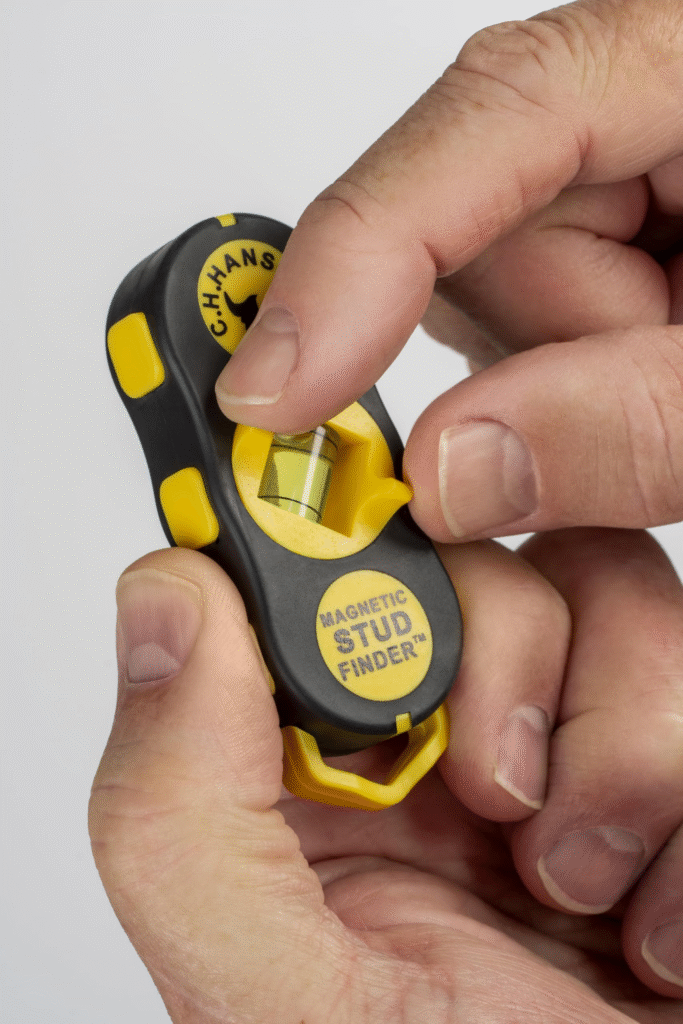
No batteries. No calibration. No beeping. The C.H. Hanson is two strong neodymium magnets in a smart housing, and in our testing, it had the strongest magnetic pull of any magnetic finder we tried. When it finds a drywall screw or nail, you feel it. There’s no ambiguity, no false readings—just a satisfying snap as the magnet grabs the fastener.
The rotating bubble level works vertically or horizontally, letting you mark plumb studs or level lines. The center mark notch aligns your pencil precisely. A loop at the bottom lets you hang a plumb bob for full-length stud marking.
On standard drywall with properly installed screws or nails, magnetic finders are surprisingly accurate. Studs are typically 16 inches apart, so once you find one fastener, you can estimate the next. The C.H. Hanson’s strong magnets snap faster and hold more securely than competitors, giving you confidence in your marks.
The catch? Magnetic finders only find fasteners, not studs themselves. If a previous owner used adhesive, irregular spacing, or minimal fasteners, you’ll get inconsistent results. They don’t work on lath-and-plaster at all. And they can’t detect wires or pipes.
Buy this if: You want a dead-simple, no-battery tool for standard drywall, or need a reliable backup to your electronic finder.
Skip this if: You work on lath-and-plaster, need wire detection, or want center-finding without measuring.
Pros
- Strongest magnets in our magnetic finder tests
- No batteries ever needed
- Rotating bubble level for vertical and horizontal use
- Center mark notch for precise marking
- Plumb bob loop for full-length stud marking
- Inexpensive and indestructible
Cons
- Only finds fasteners, not studs directly
- Useless on lath-and-plaster
- No wire or pipe detection
- Accuracy depends on installer fastener placement
6. Zircon MultiScanner A250 — Easiest Electronic Stud Finder to Use
Price: ~$60 | Type: Electronic Multi-Mode Scanner | Scan Depth: 0.75 in | Power: 9V battery
The Short Review
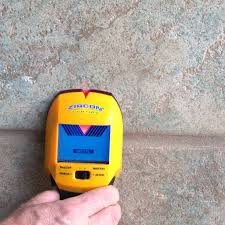
The A250 is what we hand to someone who’s never used a stud finder before. Four modes—wood stud, metal, deep scan, and live wire—selected with a simple switch. A backlit screen that clearly shows what you’ve found. Audible and visual alerts that confirm detection. In our testing, it worked nearly flawlessly on drywall.
When you pass over a stud, the screen lights up with a red arrow projected on the wall showing the center point. The deep-scan setting identifies objects deeper in the wall with a depth gauge display. Metal mode picks up iron and copper pipes. Wire detection displays a live AC icon in any mode when you pass over electrical cables.
The color-coded display is a genuine improvement over previous Zircon models: blue for metal scanning, green for wood studs, red for live wires. No more squinting at tiny icons.
On plaster walls, it worked well but was slightly less accurate, with occasional false alerts. A second scan higher or lower on the wall usually confirmed or eliminated these. It doesn’t always pick up plastic pipes, but that’s true of most electronic finders under $100.
Buy this if: You want multi-mode capability without the Bosch’s complexity, or need an intuitive tool for occasional DIYers in your household.
Skip this if: You need full-width visualization, or primarily work on plaster where the Franklin M210 performs better.
Pros
- Four scan modes cover most home scenarios
- Color-coded backlit display is easy to read
- SpotLite arrow projects center point on wall
- Deep scan with depth gauge
- Intuitive enough for first-time users
Cons
- Occasional false alerts on plaster walls
- Doesn’t consistently detect plastic pipes
- 9V battery less convenient than AA
- Premium price for feature set
7. Klein Tools ESF150LL — Best Stud Finder with Laser Leveling
Price: ~$64 | Type: Electronic with Laser | Scan Depth: 1.5 in | Power: 2× AA batteries
The Short Review
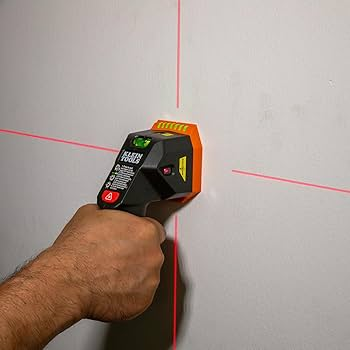
The Klein ESF150LL looks unconventional—like a stud finder crossed with a laser level—and that’s exactly what it is. The pistol-grip design keeps your hand out of the way of projected lines. A trigger activates scanning; three quick presses lock it in continuous mode for marking multiple studs without holding the button.
The real magic is the laser projection. Vertical lines shoot up and down from the stud location, letting you mark from floor to ceiling without moving the tool. Horizontal lines level across multiple stud locations, making picture hanging and shelving installation dramatically faster. The bubble level ensures your lasers are plumb and level.
In our testing, the grip was the most comfortable of any stud finder we used. The bright LEDs clearly indicate edges and center. The trigger can be momentary or continuous. And the whole-stud display shows width simultaneously.
The downside is no wire detection—a surprising omission at this price. And it gave more odd readings on lath-and-plaster than competitors. But for drywall projects where you need both stud finding and leveling, it’s the only tool that does both well.
Buy this if: You hang lots of pictures, install shelving, or do trim work where leveling matters as much as stud finding.
Skip this if: You need wire detection, or want the simplest possible operation.
Pros
- Pistol-grip design is the most comfortable we tested
- Projects vertical and horizontal laser lines
- Bubble level keeps lasers plumb and level
- Continuous scan mode for multiple studs
- Whole-stud width display
Cons
- No wire detection
- More false readings on lath-and-plaster than competitors
- Laser can only project horizontally, not vertically for ceiling work
- Larger than standard stud finders
8. Franklin Sensors ProSensor 710 — Best Pro-Grade Stud Finder on a Budget
Price: ~$50 | Type: Electronic Full-Width Scanner | Scan Depth: 1.7 in | Power: 2× AA batteries
The Short Review
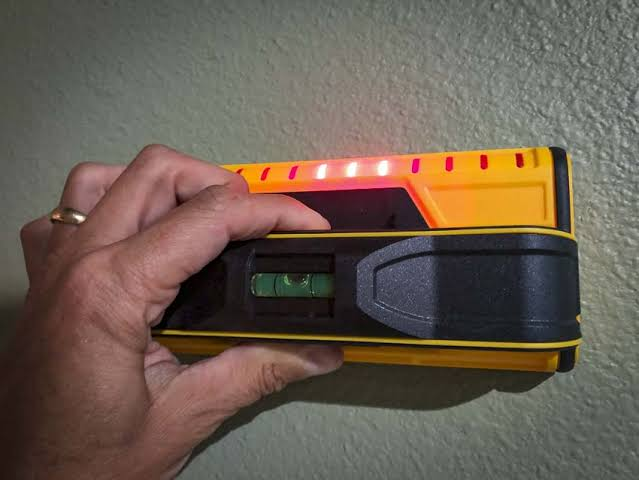
The ProSensor 710 is the M210’s slightly simpler sibling, offering the same 13-sensor full-width detection at a lower price. In our testing, it located studs with the same accuracy and speed as the M210, showing the complete stud width on a 13-LED display (versus the M210’s 21 LEDs).
It detects wood and metal studs, shows the full width, indicates center, and warns of live wires. The auto-depth adjustment handles wall thickness up to 1.7 inches without switching modes. No calibration needed—just press and scan.
What you give up versus the M210: no bubble level, no pencil caddy, fewer LEDs for precision centering, and a slightly less refined feel. But the core technology—the 13-sensor array that makes Franklin famous—is identical.
For professional contractors who lose or damage tools regularly, or homeowners who want Franklin accuracy without every premium feature, the 710 is the smart choice.
Buy this if: You want Franklin’s full-width detection at a lower price, or need a pro-grade backup to your primary finder.
Skip this if: You want the bubble level, pencil caddy, or maximum LED precision of the M210.
Pros
- Same 13-sensor accuracy as the flagship M210
- Full-width stud detection with center indication
- No calibration required
- Live wire detection
- Lower price than M210 with identical core performance
Cons
- Fewer LEDs than M210 for center precision
- No bubble level or pencil caddy
- Does not differentiate wood from metal
- Heavier than basic electronic finders
9. The StudBuddy Magnetic Stud Finder — Best No-Batteries Value Pack
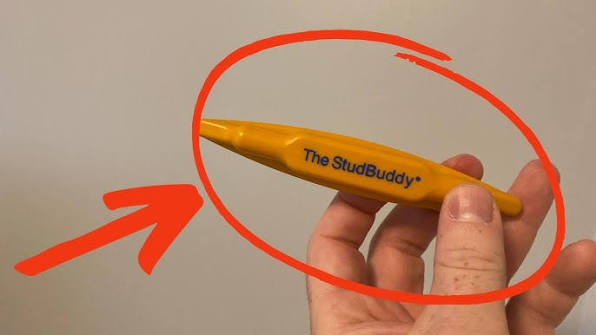
Price: ~$18 (2-pack) / ~$10 (single) | Type: Magnetic | Scan Depth: ~0.75 in | Power: None—permanent magnets
The Short Review
The StudBuddy’s genius is simplicity and value. For $18, you get two magnetic finders—leave one on the first stud while you search for the next, or use one high and one low to mark a full stud length. The long, narrow design orients vertically for a clearer picture of stud location than round magnetic finders.
In our testing, the magnets weren’t quite as strong as the C.H. Hanson, but they were more than adequate for standard drywall. The wide magnet spacing made detection faster—more surface area scanning at once. And the narrow profile, when held vertically, gave a clearer indication of stud direction than smaller circular options.
Made in the USA, the StudBuddy slides easily across walls and finds fasteners reliably. The two-pack value is unbeatable for anyone who wants a backup, has multiple household members doing projects, or likes leaving one finder in place while searching with another.
The same magnetic limitations apply: no plaster, no wires, no pipes, and accuracy depends on fastener placement. But for standard drywall in modern construction, it’s a reliable, zero-maintenance solution.
Buy this if: You want two finders for the price of one, need a no-battery backup, or like the leave-one-in-place workflow.
Skip this if: You need one premium magnetic finder with a level, or work on non-drywall surfaces.
Pros
- Two-pack value at $18
- No batteries ever
- Long narrow design orients vertically for clear stud direction
- Made in the USA
- Leave-one-in-place workflow is genuinely useful
Cons
- Magnets slightly weaker than C.H. Hanson
- No bubble level or additional features
- Same plaster and wire-detection limitations as all magnetic finders
10. Ryobi ESF5002 — Best Stud Finder for Ryobi Tool Owners
Price: ~$34 | Type: Electronic Full-Width Scanner | Scan Depth: 1.5 in | Power: 2× AA batteries
The Short Review
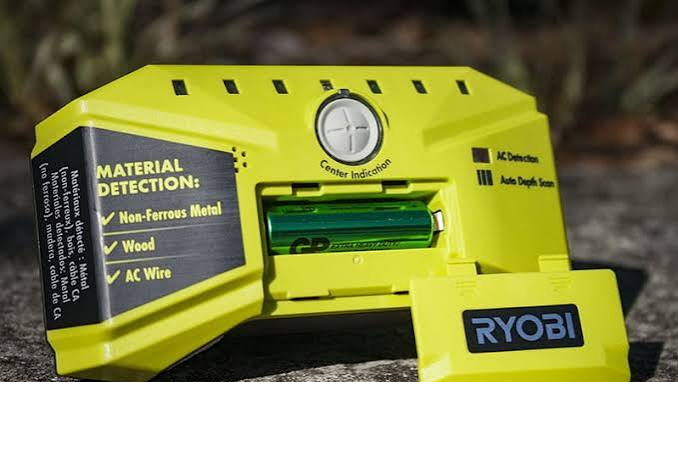
The Ryobi ESF5002 offers full-width stud detection with a unique center-punch feature: a button with a sharp point that marks the wall when you push it, no pencil needed. Green LEDs show edges and center clearly, and auto-depth scanning adjusts for wall thickness up to 1.5 inches.
In our testing, it performed well on drywall and paneling, accurately locating wood and metal studs. The center punch is genuinely convenient for quick marking, though it leaves small divots you’ll need to patch later. A pencil notch next to the LEDs offers a no-damage alternative.
The ESF5002 is light but large—one of the biggest tools in our test group. It gave lots of false readings on lath-and-plaster, where the Franklin M210 and Bosch performed better. And there’s no wire detection, which is a significant omission at this price point.
For Ryobi loyalists who want to stay in the ecosystem, it’s a solid choice. For everyone else, the Zircon A100 or Franklin 710 offer more value and features at similar or lower prices.
Buy this if: You’re invested in the Ryobi battery/tool ecosystem and want matching aesthetics, or like the center-punch marking feature.
Skip this if: You need wire detection, work on plaster walls, or want the best value in this price range.
Pros
- Full-width stud detection with edge and center LEDs
- Unique center-punch button for instant marking
- Auto-depth scanning up to 1.5 inches
- Bright, easy-to-read LEDs
- Pencil notch for no-damage marking
Cons
- No wire detection
- Many false readings on lath-and-plaster
- Larger than competitors despite being lightweight
- Less value than Zircon A100 or Franklin 710 at similar price
Complete Buying Guide: How to Choose the Right Stud Finder
Electronic vs. Magnetic: Which Do You Need?
Electronic Stud Finders send signals into your wall and interpret the returning data. They detect density changes (studs), metal, and live wires. Most offer center-finding, edge-finding, or full-width visualization. They require batteries and calibration but provide far more information and safety.
Magnetic Stud Finders use strong magnets to locate the nails and screws that fasten drywall to studs. They’re dead-simple, battery-free, and inexpensive. But they only find fasteners—not studs directly—and they’re useless on lath-and-plaster or walls with irregular fastener placement.
For most homeowners: Start with an electronic finder that detects studs and wires. Add a magnetic finder as a backup or for quick checks.
Key Features Explained
Scan Depth — How far into the wall the sensor penetrates. Standard drywall is 0.5 inches thick. Older homes with plaster, double drywall, or thick paneling need 1.5+ inches. The Bosch GMS120’s 4.75-inch depth handles almost anything.
Center vs. Edge Finding — Edge finders locate one side of the stud; you find the other edge and measure to center. Center finders calculate the middle automatically. Full-width finders (Franklin) show the entire stud at once. Center and full-width are faster and more accurate.
Live Wire Detection — Critical safety feature. AC wire indicators warn you before drilling into electrical. The best models (Bosch, Zircon A250, Franklin) show proximity or exact location. Never rely solely on this—turn off breakers when possible.
Calibration — Most electronic finders need calibration against a blank section of wall before scanning. The Franklin M210 and 710 don’t require this, which saves time and reduces user error.
Material Differentiation — Advanced scanners (Bosch GMS120) distinguish wood studs from metal studs from pipes from wires. Basic finders just say “something’s there.”
What We Learned After Testing 10+ Stud Finders
Accuracy varies more than you’d expect. Every finder in our test located studs on standard drywall. The differences show up on thick walls, plaster, and when distinguishing materials. The Bosch and Franklin consistently outperformed on challenging surfaces.
Wire detection is worth paying for. Even basic wire warning (Zircon A100) prevented us from drilling into live circuits multiple times. The peace of mind alone justifies the extra $10–$20.
Magnetic finders are surprisingly capable on modern drywall. If your home was built in the last 30 years with standard construction, a $15 magnetic finder will locate studs accurately 90% of the time. The catch is that 10% when fasteners are irregular or absent.
Plaster walls break most electronics. Lath-and-plaster is the ultimate stud finder torture test. The Franklin M210 performed best, but even it struggled occasionally. For old homes, consider a combination approach: magnetic for initial sweeps, electronic for confirmation, and a small finish nail for verification.
Weight matters for extended use. The Franklin M210 at 11.5 ounces feels substantial during a full room scan. The Craftsman at a few ounces is effortless. For occasional use, weight is irrelevant. For contractors or big projects, lighter tools reduce fatigue.
Price Ranges — What to Expect
Budget ($10–$20): Basic magnetic finders and simple edge-detection electronics. Reliable for standard drywall, limited features. Examples: Craftsman CMHT77633, C.H. Hanson 03040, StudBuddy.
Mid-Range ($30–$60): Center-finding electronics with wire detection and deep scan. The sweet spot for most homeowners. Examples: Zircon A100, Zircon A250, Ryobi ESF5002, Franklin ProSensor 710.
Premium ($60–$100): Full-width visualization, material differentiation, laser leveling, and maximum scan depth. Examples: Franklin ProSensor M210, Klein ESF150LL, Bosch GMS120.
Final Tips Before You Buy
Know your walls. Standard modern drywall? Almost anything works. Lath-and-plaster? Invest in the Franklin M210 or Bosch. Thick paneling or double drywall? You need deep scan capability.
Test on a known stud first. Every finder behaves slightly differently. Before trusting it on an important project, verify it finds a stud where you know one exists (next to an outlet, under a window).
Mark both edges and center. Even center-finding tools benefit from edge confirmation. A 1.5-inch stud center gives you wiggle room; knowing the edges ensures your anchor bites solid wood.
Don’t trust any finder blindly. Use additional clues: outlets are usually mounted to studs, baseboard nails often hit studs, and 16-inch spacing is standard. Cross-reference your finder results with these visual cues.
Turn off the breaker when possible. Wire detection helps but isn’t foolproof. For any drilling near electrical, kill the power. No stud finder replaces basic electrical safety.
Frequently Asked Questions
Q: Do stud finders really work, or are they gimmicks?
A: Quality electronic stud finders absolutely work on standard drywall. Our testing confirmed consistent accuracy within 1/16 inch for center-finding models. Magnetic finders work well on modern construction with proper fastener placement. Cheap, no-brand electronics are often unreliable—stick to established brands.
Q: Why does my stud finder beep everywhere?
A: You’re probably not calibrating properly. Most electronic finders need to calibrate against a blank wall section before scanning. Start on an area you know is empty, hold the button until calibrated, then scan slowly. Thick wallpaper, metallic paint, or dense plaster can also cause false readings.
Q: Can a stud finder detect pipes and wires?
A: Advanced models can. The Bosch GMS120 detects copper pipes and live AC wires. The Zircon A250 and Franklin M210 detect live wires. However, no consumer stud finder guarantees pipe or wire location. Always use caution, turn off breakers, and consult building plans when available.
Q: What’s the difference between edge finding and center finding?
A: Edge finders locate one side of the stud. You find the other edge and calculate center yourself. Center finders use multiple sensors to calculate the middle automatically. Full-width finders (Franklin) show the entire stud width at once. Center and full-width are faster and reduce math errors.
Q: Are magnetic stud finders accurate?
A: On standard drywall with properly installed screws or nails, yes—they’re surprisingly accurate. But they find fasteners, not studs. If fasteners are irregular, sparse, or absent (adhesive-mounted drywall), magnetic finders fail. They also don’t work on lath-and-plaster. Use them as backups, not primary tools for critical projects.
Q: Why can’t my stud finder find studs in my plaster wall?
A: Lath-and-plaster walls have irregular density, metal mesh, and thick surfaces that confuse electronic sensors. The Franklin M210 performed best in our plaster tests, but even it struggled occasionally. For old plaster, try a magnetic finder on baseboard nails, use outlet locations as clues, or drill small test holes with a finish nail.
Q: How do I know if I found a stud or just a pipe?
A: Advanced scanners (Bosch GMS120) differentiate materials and display icons. Basic finders just say “something dense is here.” Tap the wall—a stud sounds solid, a pipe may sound hollow or metallic. Move vertically: studs run floor to ceiling, pipes often run horizontally. When in doubt, drill a small test hole with a finish nail before using a large bit.
Q: Can I use a stud finder on ceilings?
A: Yes, but it’s harder. Gravity works against you, and ceiling joists may be 24 inches apart instead of 16. Most electronic finders work on ceilings in stud scan mode. The Klein ESF150LL’s vertical laser lines are particularly helpful for marking ceiling joists.
Q: What’s the best stud finder for a beginner?
A: The Zircon StudSensor A100. It’s intuitive, accurate, has wire detection for safety, and costs about $33. The SpotLite Pointer shows exactly where to mark. No complex modes to learn. The Franklin M210 is even easier (no calibration), but costs nearly twice as much.
Q: Do I need to replace my stud finder regularly?
A: Magnetic finders last indefinitely. Electronic finders should be replaced when they give inconsistent readings, fail to calibrate, or show physical damage. Most quality electronics last 5+ years with normal use. The Craftsman’s lifetime warranty is exceptional; most others offer 1–3 years.
Disclosure: We independently research and test products. When you buy through links on our site, we may earn an affiliate commission at no extra cost to you.