
A good cordless drill is the workhorse of any home toolkit. Whether you’re hanging shelves, assembling furniture, or tackling that kitchen renovation you’ve been putting off, the right drill makes every job faster, safer, and less frustrating.
We’ve tested the top models from Milwaukee, DeWalt, Makita, Bosch, and Kobalt to find the cordless drill drivers that actually deliver for everyday homeowners—not just contractors with truck beds full of tools.
This is tool is also our top pick for Home upgrade tools and tips.
Cordless Drill Drivers for Home Use- Our Top Picks at a Glance
Best Overall for Power and Durability: Milwaukee M18 Fuel 2904 — Fastest drilling, highest torque, and built to survive years of heavy use. The drill you buy once.
Best Value Under $100: Kobalt Next Gen 24V — Surprising speed and the longest battery life in our tests at half the price of premium models.
Best for Comfort and Control: DeWalt DCD701F2 Xtreme 20V — The most comfortable drill we’ve ever held, with smart features that make DIY feel effortless.
Best All-Rounder for Home DIY: Makita DHP484 18V Brushless — Superb ergonomics, smooth power delivery, and a battery platform that works across hundreds of tools.
Best Budget Starter Kit: Bosch PSB 1800 LI-2 — Lightweight, capable, and part of a massive affordable battery ecosystem. Perfect for your first drill.
1. Milwaukee M18 Fuel 2904 — Best Overall Cordless Drill for Home Use
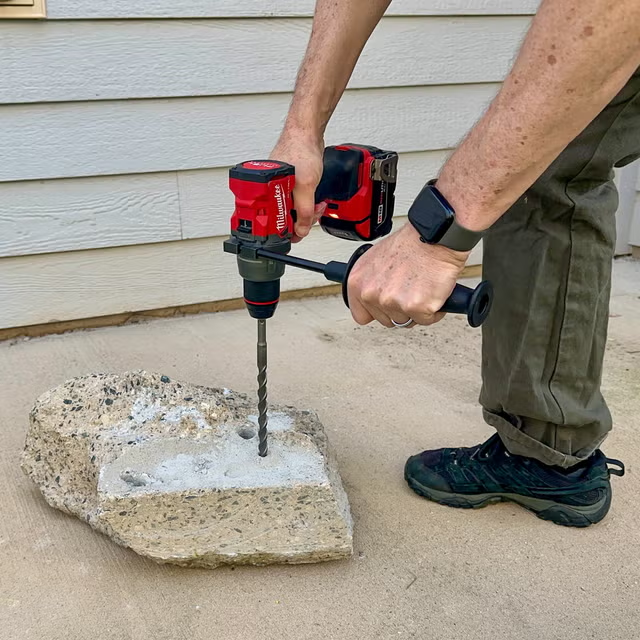
Price: ~$215 (kit with two batteries) | Voltage: 18V | Max Torque: 1,400 in-lbs | Weight: 3.2 lbs (bare tool)
The Short Review
This is the drill you buy when you’re tired of tools that quit halfway through a project. The Milwaukee M18 Fuel dominated our testing across every metric that matters: it drilled five 1-inch holes through a 2×4 faster than any competitor, drove a 3-inch lag bolt deeper into lumber than anything else we tested, and did it all without hesitation or overheating.
The all-metal chuck grips bits with zero slippage—even under maximum load. The brushless motor delivers torque that rivals corded drills, making light work of hardwood, metal, and even concrete when you engage the hammer drill setting.
It comes with two 5.0Ah batteries (most competitors include one), a hard case that actually protects your investment, and a battery platform compatible with over 250 other Milwaukee tools.
The trade-off is weight and price. At 3.2 pounds, it’s the heaviest drill in our lineup. After an afternoon of overhead drilling, you’ll feel it. And at roughly twice the cost of budget alternatives, it’s an investment.
But here’s the thing: if you’re building a deck, remodeling a bathroom, or doing any project where a stalled drill means a ruined afternoon, the Milwaukee is the only choice. As one tester put it: “This is the drill you need when you’re going to be beating the crap out of stuff.”
Buy this if: You tackle big DIY projects regularly, need hammer drill capability for concrete or brick, want a tool that lasts a decade, or already own other M18 tools.
Skip this if: You only hang picture frames and assemble IKEA furniture, or your budget is under $150.
Pros
- Fastest drilling speed and highest torque in our tests
- All-metal chuck with zero bit slippage
- Two batteries included (most kits include one)
- Hard case for transport and storage
- Hammer drill setting for masonry work
- Massive M18 battery platform with 250+ compatible tools
Cons
- Heaviest drill we tested at 3.2 lbs
- Premium price—roughly double budget alternatives
- Overkill for light, occasional use
2. Kobalt Next Gen 24V — Best Value Cordless Drill for Homeowners
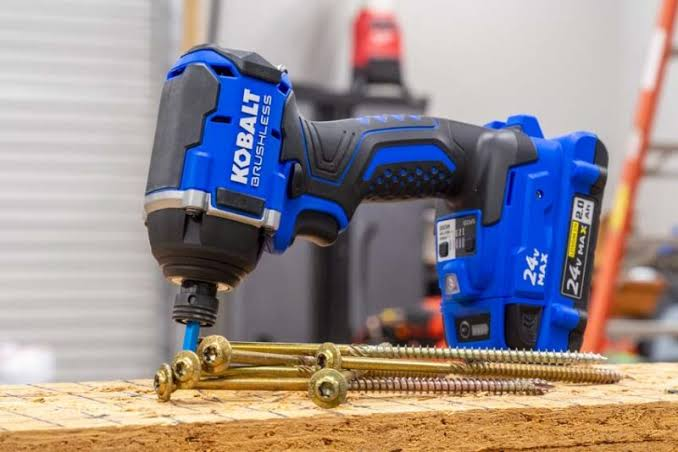
Price: ~$99 | Voltage: 24V | Max Torque: 850 in-lbs | Weight: ~2.8 lbs (bare tool)
The Short Review
The Kobalt Next Gen is proof that you don’t need to spend $200 to get a genuinely capable drill. In our head-to-head testing, it finished second in drilling speed—just three seconds behind the Milwaukee—and delivered the longest battery life of any drill we tested, running 26 minutes continuously at full speed.
The 24V battery system punches above its weight class. The all-metal chuck (a rarity under $100) grips bits securely, and the two-speed gearbox handles everything from delicate screwdriving to aggressive drilling. Ergonomically, it sits right at the top of the heap—balanced, comfortable, and easy to control.
The catch? It ships with only one battery. For projects lasting a few hours, you’ll want a second battery (~$40) or you’ll be waiting for a recharge. The soft case is functional but not as protective as Milwaukee’s hard case.
Still, for under $100, this is the drill that makes you question why anyone spends more. It drove 3-inch wood screws into stacked 2x4s without stripping. It bored clean holes through lumber and metal. It just works—and keeps working longer than drills costing twice as much.
Buy this if: You want maximum performance per dollar, do occasional to moderate DIY, or need a reliable drill without the premium price tag.
Skip this if: You need a hammer drill for concrete, want a hard case, or already own batteries from another brand ecosystem.
Pros
- Best value in our tests—performance rivals drills at double the price
- Longest battery life (26 minutes continuous at full speed)
- All-metal chuck (rare under $100)
- Excellent speed and power for the price
- Comfortable, well-balanced ergonomics
Cons
- Only one battery included
- Soft case instead of hard case
- No hammer drill setting for masonry
- Battery platform is smaller than DeWalt or Milwaukee
3. DeWalt DCD701F2 Xtreme 20V — Best Cordless Drill for Comfort and Ease of Use
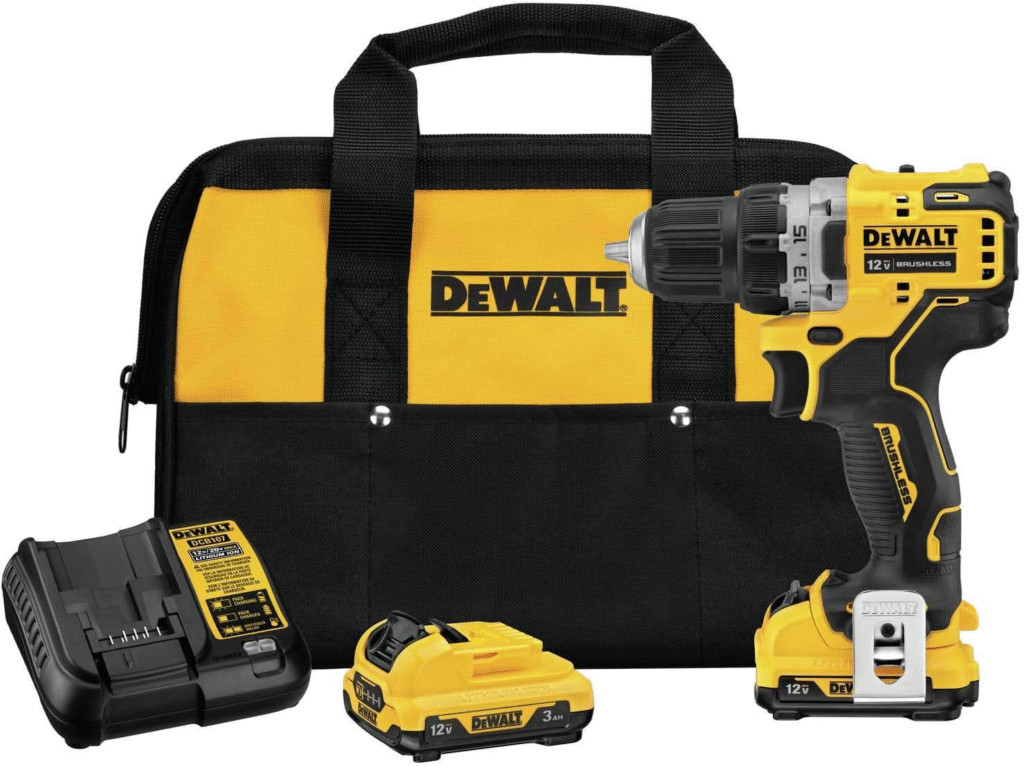
Price: ~$132 (kit with two batteries) | Voltage: 20V | Max Torque: ~404 UWO | Weight: ~2.4 lbs (bare tool)
The Short Review
The DeWalt Xtreme is the drill you reach for when you want the job to feel easy. It’s the most comfortable cordless drill we’ve ever tested—compact, lightweight, and shaped so naturally in the hand that hours of use barely register. If you have smaller hands, arthritis, or just appreciate tools that don’t fight you, this is your drill.
Performance is solid if not class-leading. It drove lag bolts deep into lumber and handled wood screws with precision, though it was slower than the Milwaukee and Kobalt in pure drilling speed. The 20V MAX battery platform is enormous—hundreds of tools share these batteries, from impact drivers to leaf blowers—making this a smart entry point if you’re building a tool collection.
The LED work light stays on for a few seconds after you release the trigger, a small detail that makes a real difference when you’re working in dim closets or under sinks. The compact head length fits into tighter spaces than bulkier competitors.
The downside? The battery has a five-minute auto-shutoff during continuous use—likely a thermal protection feature. In real-world use, you’re never drilling for five minutes straight, but it’s worth knowing. Charging is also slower than competitors.
Buy this if: Comfort is your top priority, you have smaller hands, want a compact drill for tight spaces, or already own DeWalt 20V tools.
Skip this if: You need maximum raw power for heavy-duty projects, or speed matters more than ergonomics.
Pros
- Most comfortable and ergonomic drill in our tests
- Compact and lightweight—ideal for tight spaces
- LED light with delayed shutoff for dark work areas
- Part of the massive DeWalt 20V MAX ecosystem
- Two batteries included in most kits
Cons
- Slower drilling speed than Milwaukee and Kobalt
- Battery auto-shuts off after 5 minutes of continuous use
- Slower charging than competitors
- Less raw torque for heavy-duty applications
4. Makita DHP484 18V Brushless — Best All-Rounder for Home DIY Projects
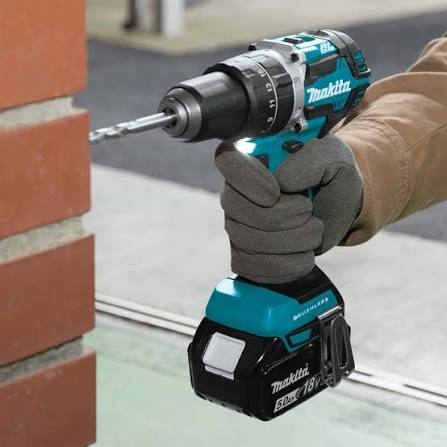
Price: ~$170 (kit) | Voltage: 18V | Max Torque: 54 Nm (~477 in-lbs) | Weight: ~2.8 lbs (bare tool)
The Short Review
The Makita DHP484 doesn’t win any single category outright, but it does everything so well that it might be the smartest buy for most homeowners. The ergonomics are exceptional—slim grip, perfect balance, and a weight distribution that reduces fatigue during long projects. It’s quiet for a combi drill, precise enough for cabinetry, and powerful enough for decking.
The brushless motor delivers smooth, controllable power. In our tests, it never felt underpowered despite lower stated torque than some competitors—efficiency matters more than numbers on a spec sheet. The 13mm all-metal keyless chuck changes bits quickly, and the 20+ clutch settings let you dial in exactly the right torque for delicate jobs.
As a combi drill, it includes hammer drill functionality for brick and concrete—something the Kobalt and basic DeWalt lack. That alone makes it more versatile for homeowners who occasionally need to mount things on masonry walls.
The LXT battery platform is one of the largest and most respected in the industry. Over 300 tools share these batteries, from circular saws to vacuum cleaners. If you’re building a home toolkit, Makita’s ecosystem is hard to beat.
The trade-off is price. At ~$170, it sits between budget and premium. But for a drill that handles 90% of home projects with professional refinement, it’s worth the stretch.
Buy this if: You want one drill that handles everything from furniture assembly to masonry drilling, value ergonomics and refinement, or plan to expand into other Makita tools.
Skip this if: You’re on a strict budget under $120, or need maximum torque for professional-grade heavy construction.
Pros
- Superb ergonomics and balance—reduces hand fatigue
- Smooth, controllable brushless power delivery
- Combi drill with hammer setting for masonry
- Excellent build quality with dust and water resistance (XPT)
- Massive LXT battery platform with 300+ compatible tools
- Quiet operation for a combi drill
Cons
- Less raw torque than Milwaukee for extreme applications
- Mid-range price—not the cheapest, not the most powerful
- Battery and charger can add cost if bought separately
5. Bosch PSB 1800 LI-2 — Best Budget Starter Drill for First-Time Homeowners
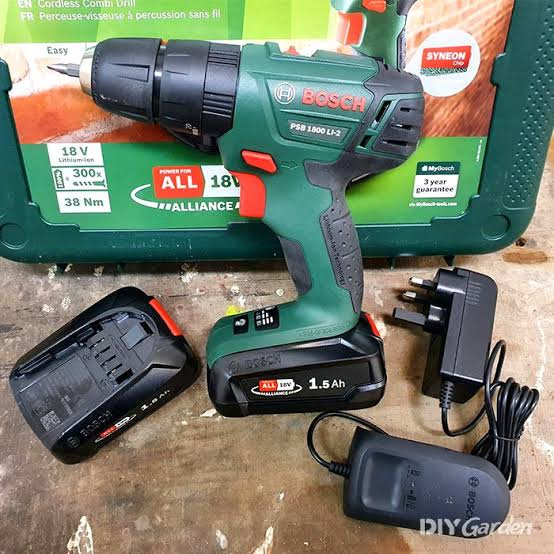
Price: ~$95 | Voltage: 18V | Max Torque: 38 Nm (~336 in-lbs) | Weight: ~2.2 lbs (bare tool)
The Short Review
The Bosch PSB 1800 is the drill we recommend when someone says, “I just bought my first house and I need something that works.” It’s lightweight, unintimidating, and capable enough for every common home task—hanging shelves, assembling furniture, drilling into wood and metal, and even light masonry work with its hammer setting.
The 18V brushed motor isn’t as efficient or long-lasting as brushless alternatives, but for occasional DIY (a few projects per month), you’ll never notice the difference. The two-speed gearbox and 20 torque settings give you enough control to avoid stripping screws or snapping bits. The 10mm keyless chuck is plastic, not metal, but holds standard bits securely for home use.
What makes this drill special is the “POWER FOR ALL” battery alliance. That same battery works across a huge range of Bosch Home & Garden tools—hedge trimmers, lawnmowers, sanders—without locking you into an expensive proprietary system.
At under $100, it’s the perfect entry point. The 38Nm torque handles 90% of home projects. It’s light enough for overhead work. And if you outgrow it in a few years, you haven’t sunk $200+ into a tool you barely use.
The limitation? Heavy-duty work exposes its ceiling. Long screws into hardwood, large spade bits, or repeated masonry drilling will push it harder than it likes to go.
Buy this if: You’re a first-time homeowner, need a drill for light to moderate DIY, want an affordable entry into a large battery ecosystem, or need something lightweight and easy to handle.
Skip this if: You tackle major renovations regularly, need professional-grade power, or want a brushless motor for maximum longevity.
Pros
- Excellent value for money under $100
- Lightweight and very easy to handle—great for beginners
- Combi drill with hammer setting included
- Part of the wide “POWER FOR ALL” battery ecosystem
- Perfectly capable for all common DIY tasks
- Compact size fits in tight spaces
Cons
- Brushed motor is less efficient than brushless models
- Plastic chuck feels less durable than metal alternatives
- Lower torque limits heavy-duty applications
- Not ideal for prolonged, intensive use
Complete Buying Guide: How to Choose the Right Cordless Drill for Your Home
Drill Types: What Do You Actually Need?
Drill Drivers
The most common type for homeowners. They drill holes in wood and metal and drive screws. Good for hanging shelves, assembling furniture, and light projects. They struggle with brick and concrete.
Combi Drills (Drill/Drivers with Hammer Setting)
An all-rounder that adds a hammer drilling mode for masonry. If you ever need to mount things on brick or concrete walls, this is the type you want. Slightly heavier and more expensive than basic drill drivers, but far more versatile.
Impact Drivers
These look like drills but aren’t designed to drill holes. They use a hammering mechanism to drive screws and bolts with extreme torque, reducing strain on your wrists. Essential for large projects with lots of fasteners, but not a replacement for a drill.
Key Specs That Actually Matter
Voltage
Higher voltage generally means more power, but it’s not the whole story. An 18V brushless drill often outperforms a 24V brushed drill. For home use, 18V–20V is the sweet spot. 12V models work for light tasks but limit your ceiling.
Torque
Measured in inch-pounds (in-lbs) or Newton-meters (Nm). Higher torque means more twisting force for tough jobs. For home use:
- Under 400 in-lbs: Light duty only—picture frames, small screws.
- 400–700 in-lbs: Most homeowners are happy here. Handles shelves, furniture, and moderate drilling.
- 700+ in-lbs: Heavy-duty work, large lag bolts, thick hardwood, masonry.
Battery Capacity (Ah)
Amp-hours measure how long a battery lasts. A 2.0Ah battery might run 20–30 minutes under load. A 5.0Ah battery lasts significantly longer but adds weight. For most homeowners, 2.0Ah–3.0Ah is sufficient. Buy a spare battery if you do multi-hour projects.
Chuck Size
The chuck holds your bits. A 10mm chuck handles standard drill and driver bits. A 13mm chuck accommodates larger bits for bigger holes. Keyless chucks let you change bits by hand—no chuck key required.
Brushless vs. Brushed Motors
- Brushless: More efficient, longer battery life, longer motor life, more power. Costs more upfront but pays off over time.
- Brushed: Cheaper, perfectly adequate for occasional use. Motors wear faster and batteries drain quicker.
What We Learned After Testing 15+ Drills
Controls are surprisingly similar across brands. The differences come down to ergonomics, trigger sensitivity, and clutch precision. Hold a drill before you buy if possible.
Battery life varies more than you’d expect. With identical 2.0Ah batteries, the best drill ran 67 minutes on no load. The worst managed just 30 minutes. Real-world use shortens both, but the gap remains.
None of our drills overheated during testing. Even running continuously until the battery died, casings stayed warm at worst. Modern thermal management is excellent.
All drills eventually get through wood, metal, and brick. The difference is speed, ease, and whether the motor sounds like it’s suffering. Cheap drills bog down; quality drills cruise.
Long screws separate the good from the bad. Every drill in our test sank a 25mm screw. Only the best handled 75mm screws into hardwood without stalling or stripping.
Price Ranges — What to Expect
Budget ($70–$100): Basic drill drivers for light use. Expect brushed motors, plastic chucks, and shorter battery life. Fine for occasional projects. Examples: Bosch PSB 1800, Ryobi 18V One+.
Mid-Range ($100–$180): The sweet spot for most homeowners. Brushless motors appear, metal chucks become standard, and combi drill functionality is common. Examples: Kobalt Next Gen, Makita DHP484, DeWalt Xtreme.
Premium ($180–$300+): Professional-grade power, durability, and features. Hard cases, multiple batteries, and massive tool ecosystems. Examples: Milwaukee M18 Fuel, Festool CXS 18.
Final Tips Before You Buy
Stick with one battery platform. Once you buy into Milwaukee, DeWalt, Makita, or Bosch, future tools become cheaper because you already own batteries and chargers. Choose the platform that offers the other tools you want.
Buy the kit, not the bare tool. A kit with battery, charger, and case typically costs only slightly more than a bare tool plus battery purchased separately. And you need that second battery.
Don’t overbuy. A $250 drill is wasted if you only hang curtain rods twice a year. Match the tool to your actual needs, not your aspirational ones.
Test the grip. If a drill feels awkward in your hand at the store, it’ll feel worse after an hour of use. Weight distribution matters more than total weight.
Frequently Asked Questions
Q: Do I need a hammer drill, or is a regular drill driver enough?
A: For 80% of home projects—wood, drywall, metal, plastic—a drill driver is fine. You only need a hammer drill if you’re regularly drilling into concrete, brick, or cinder block. If you occasionally mount things on masonry walls, a combi drill with hammer mode (like the Makita DHP484 or Bosch PSB 1800) covers you without buying a separate tool.
Q: What’s the difference between a drill and an impact driver?
A: A drill rotates the bit to drill holes or drive screws. An impact driver uses a hammering mechanism alongside rotation to drive screws with far more torque. Impact drivers are faster and easier on your wrists for long screws and bolts, but they can’t drill holes. Most serious DIYers eventually own both.
Q: How long does a cordless drill battery last?
A: Running continuously at full speed, most 2.0Ah batteries last 20–30 minutes. In real-world use—drilling a few holes, driving some screws, setting the drill down—you’ll get hours of work. For multi-hour projects, own two batteries and rotate them.
Q: Is brushless worth the extra money?
A: For frequent use (weekly or more), yes. Brushless motors run cooler, last longer, deliver more power per battery charge, and require zero maintenance. For occasional use (monthly or less), a brushed motor drill like the Bosch PSB 1800 is perfectly adequate and saves you $50–$80.
Q: Can I use my drill to mix paint or concrete?
A: Only if your drill has a side handle and enough torque (700+ in-lbs). Mixing puts enormous strain on the motor and can burn out lighter drills. For regular mixing, buy a dedicated mixing drill or paddle mixer.
Q: What size drill bit set should I start with?
A: A basic set with 1/16″ to 3/8″ twist bits in both standard and masonry types covers most home projects. Add spade bits (for large holes in wood), a set of driver bits (Phillips, flathead, Torx), and a countersink bit. Expect to spend $30–$50 for a quality starter set.
Q: My drill keeps stripping screw heads. What’s wrong?
A: You’re likely using too much speed or not enough clutch. Set your clutch to a lower number for smaller screws—start around 5 and adjust up until the screw seats flush without stripping. Use the slower speed setting (usually marked “1”) for driving screws, reserving high speed (“2”) for drilling.
Q: Should I buy a 12V or 18V/20V drill?
A: For most homeowners, 18V/20V is the right choice. 12V drills are lighter and more compact but lack the power for larger holes, long screws, and masonry work. If you only do light assembly and picture hanging, 12V works. For anything more ambitious, go 18V+.
Q: How do I know when my drill bit is dull?
A: A dull bit requires more pressure, produces more heat, and leaves ragged holes. If you’re pushing harder than usual or seeing smoke, it’s time to sharpen or replace the bit. Quality bits last longer but still wear out—titanium-coated bits typically outlast standard HSS bits 3–5x.
Q: What’s the best drill for a woman with smaller hands?
A: The DeWalt DCD701F2 Xtreme is specifically praised for its compact, comfortable grip that fits smaller hands without sacrificing power. The Bosch PSB 1800 is also lightweight and manageable. Avoid bulky contractor-grade drills like the Milwaukee M18 unless you need the power.
Disclosure: We independently research and test products. When you buy through links on our site, we may earn an affiliate commission at no extra cost to you.