
A tape measure is the tool you reach for more than almost anything else in your toolbox. Whether you’re hanging a picture frame, planning a kitchen renovation, or checking if that couch will fit through the doorway, accuracy and reliability matter.
A cheap tape that stretches, cracks, or gives inconsistent readings costs you far more than the few dollars you saved.
We’ve tested the top models from Crescent Lufkin, Milwaukee, Irwin, Stanley, and DeWalt through real-world durability trials, standout tests, and blade abuse challenges to find the tape measures that actually deserve a spot in your home.
This is tool is also our top pick for Home upgrade tools and tips.
Our Top Picks at a Glance- Tape Measures for Home Use
Best Overall Value and Durability: Crescent Lufkin Shockforce Nite — The best balance of standout performance, blade toughness, and price in our 2026 head-to-head testing.
Best for Maximum Durability: Milwaukee Stud 48-22-1425 — The toughest overall tape we tested, with the best blade coating and a wire belt clip that won’t snap.
Best for Standout Reach: DeWalt ToughSeries DWHT36925S — Longest horizontal reach in our tests, with a removable magnetic hook and jobsite-tough construction.
Best Budget Pick Under $20: Komelon Contractor TS — Surprising performance at half the price of premium tapes, with the best finger brake design we tested.
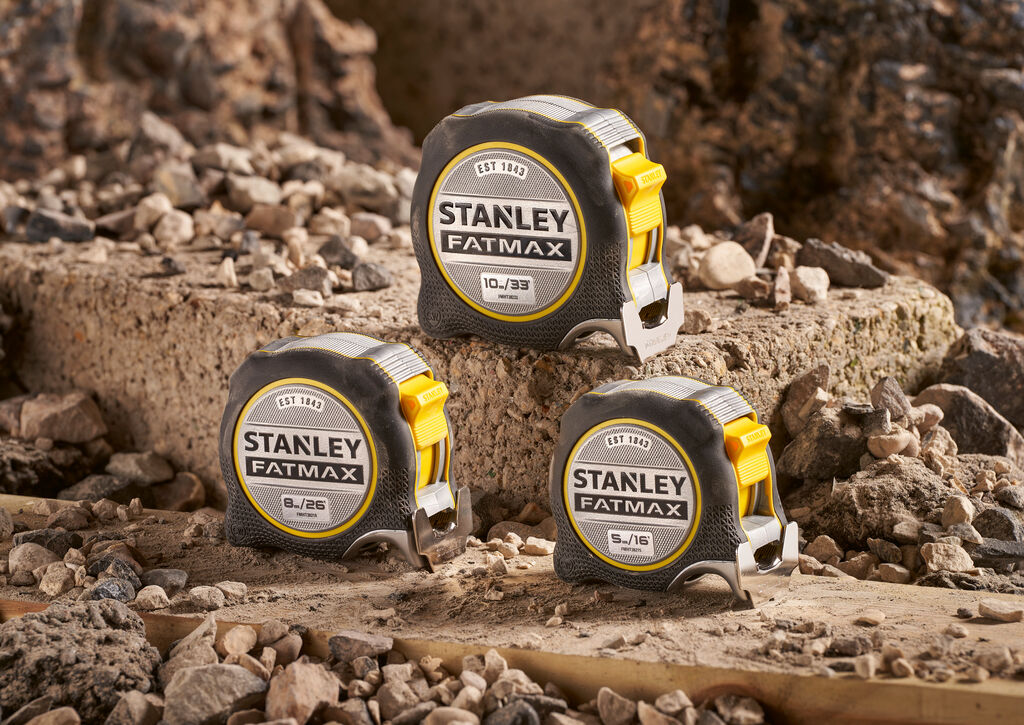
Best Classic Choice: Stanley FatMax Premium — The name most pros trust, with outstanding blade stiffness and a textured grip that feels right in any hand.
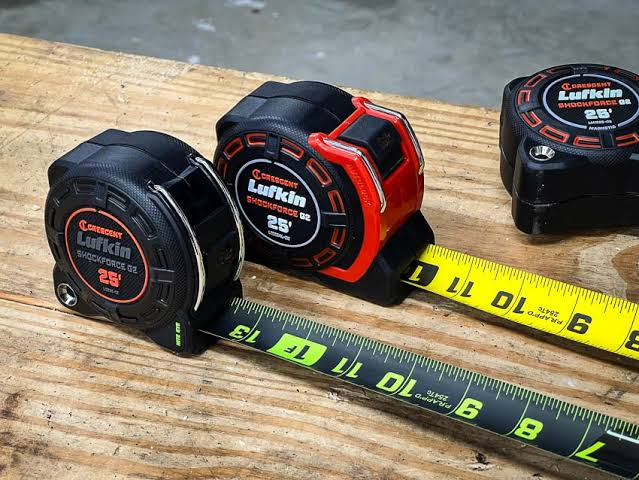
1. Crescent Lufkin Shockforce Nite — Best Overall Tape Measure for Home Use
Price: ~$25–$30 (25 ft) | Blade Width: 1.25 in | Weight: ~1.2 lbs | Rated Standout: 14 ft
The Short Review
This is the tape measure that made us rethink what “best” means. In our 2026 head-to-head testing against eight top brands, the Crescent Lufkin Shockforce Nite scored 99 points—highest in the group—and did it at a lower price than most premium competitors.
The standout feature is the blade itself. The “StableWing” design uses a slightly flattened profile that resists rollover better than traditional curved blades. In our horizontal reach test, it extended 11 feet 10 inches before dropping. More importantly, the 8-foot drop test showed the blade sagging only 13.25 inches—the best in our entire test group. That stiffness means you can measure across wide gaps, into deep corners, and over obstacles without a helper.
The Nite Eye printing is genuinely easier to read than standard markings. Reverse-contrast colors with extra-large numbers pop in dim garages and bright sunlight alike. Double-sided printing lets you read measurements from the top or bottom of the tape, which matters more than you’d think when you’re working overhead or in tight spaces.
The 360-degree diamond-coated hook grips material at any angle—no more slipping off rounded edges or smooth surfaces. And the reinforced hook mount survived our blade abuse test without damage, while the Stanley FatMax cracked under the same punishment.
The trade-off? That flatter, stiffer blade makes vertical measurements slightly harder if you don’t have a wall to lean against. For the vast majority of home projects—measuring rooms, checking lumber, marking cuts—this is a non-issue.
Buy this if: You want the best combination of durability, readability, standout, and value. This is the tape for homeowners who measure frequently and refuse to buy twice.
Skip this if: You primarily take vertical measurements without wall support, or you specifically want a magnetic hook.
Pros
- Best overall score (99/100) in our 2026 head-to-head testing
- Outstanding blade stiffness with lowest drop in the group
- Nite Eye reverse-contrast printing is the easiest to read
- 360-degree diamond-coated hook grips at any angle
- Double-sided printing for overhead and awkward-angle reading
- Reinforced hook mount survived full blade abuse test
- Excellent value—performs above its price point
Cons
- Flatter blade can work against you for unsupported vertical measurements
- No finger brake for controlled blade retraction
- No magnetic hook option
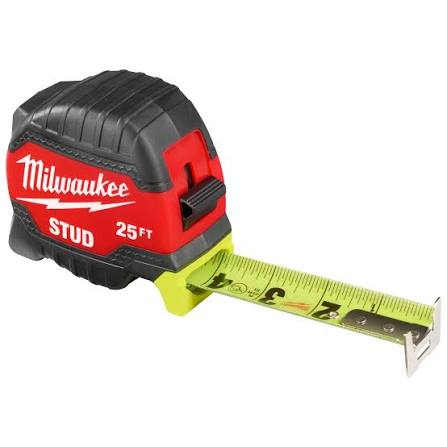
2. Milwaukee Stud 48-22-1425 — Best Tape Measure for Maximum Durability
Price: ~$32 (25 ft) | Blade Width: 1.31 in | Weight: 1.28 lbs | Rated Standout: 17 ft
The Short Review
If your tape measure lives a hard life—dropped from ladders, kicked around the garage, left out in the rain—the Milwaukee Stud is built to survive it. In our testing, it scored 98 points, just one behind the Lufkin, and proved itself the toughest overall tape in the group.
The EXO360 blade coating is the real differentiator. When you run your finger along the full length of the blade, you can feel how much thicker and more resilient Milwaukee’s coating is compared to competitors. The first six inches get an additional anti-tear layer—the section that sees the most abuse when you’re hooking onto rough lumber or concrete edges. After our full blade abuse test, the Stud emerged completely unscathed. No cracks. No flattening. No degradation.
The wire belt clip is a small detail that reveals big thinking. Most tapes use stamped steel clips that bend, snag, and eventually snap. Milwaukee’s wire clip slides smoothly over belts and pockets, holds securely, and springs back into shape indefinitely.
The finger brake—a cutout in the housing that lets you control blade retraction with your fingertip—is precise and intuitive. No more fumbling for a side lever while holding the tape extended with your other hand.
The architectural scale printed on the reverse side is genuinely useful if you read blueprints or work with building plans. And the 17-foot rated standout, while not class-leading in our real-world reach test (12 ft 1 in), is more than adequate for any home project.
The downside is size. At 1.28 pounds with a slightly bulkier housing, it’s the largest tape in our top tier. It fills a tool belt pouch more than slimmer competitors. And at $32, it’s at the top of the price range for non-specialty tapes.
Buy this if: You prioritize durability above all else, work in rough conditions, want the best blade protection available, or already carry Milwaukee tools.
Skip this if: You want the lightest, most compact tape, or your budget is under $25.
Pros
- EXO360 coating is the most durable blade protection we tested
- Additional anti-tear coating on the first six inches
- Wire belt clip outlasts stamped steel alternatives
- Finger brake for smooth, controlled retraction
- Architectural scale on reverse side
- Survived full blade abuse test with zero damage
- Excellent overall durability and build quality
Cons
- Slightly larger and heavier than competitors
- Premium price point
- Real-world standout slightly lower than rated spec
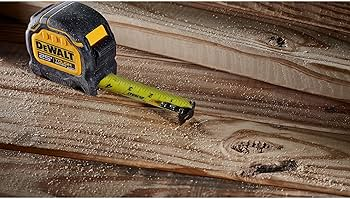
3. DeWalt ToughSeries DWHT36925S — Best Tape Measure for Standout Reach
Price: ~$32 (25 ft) | Blade Width: 1.25 in | Weight: 1.24 lbs | Rated Standout: 17 ft
The Short Review
When you need to measure across a room, into a deep closet, or over a pile of lumber without walking around it, standout matters. The DeWalt ToughSeries delivered the longest horizontal reach in our 2026 testing—12 feet 11 inches—and dropped only 14.25 inches at 8 feet, second-best in the group.
The removable magnetic hook is a feature you don’t know you need until you use it. Hook onto steel studs, ductwork, or metal framing and the magnet holds firm. Remove it when you’re measuring wood, drywall, or fabric and don’t want the magnet catching on nails or screws. It’s versatility that saves you from owning two tapes.
The blade coating, called Rip-Shield, covers the first six inches with extra protection plus standard coating on the rest. Like the Milwaukee, it survived our full blade abuse test without damage. The oversized hook improves grip on roundover edges, and double-sided printing means you can read from any angle.
The housing feels substantial in the hand without being bulky. DeWalt’s reputation for jobsite-tough tools is evident in every detail—the overmolded grip, the solid lock mechanism, the smooth blade travel.
The catch? No finger brake. You control retraction with the side lock button, which works fine but lacks the precision of a dedicated brake. And the hook connection is slightly looser than the Lufkin or Milwaukee, though still within acceptable tolerances for accurate measuring.
Buy this if: You need maximum standout reach, work with metal frequently and want a magnetic hook, or trust the DeWalt brand for jobsite durability.
Skip this if: You want a finger brake for precise retraction control, or prefer a lighter tape for pocket carry.
Pros
- Longest horizontal reach in our testing (12 ft 11 in)
- Second-lowest drop at 8 feet (14.25 in)
- Removable magnetic hook for versatile use
- Rip-Shield blade coating survived abuse test
- Oversized hook for better edge grip
- Double-sided printing
- Jobsite-tough construction
Cons
- No finger brake
- Slightly loose hook connection
- Premium price with no budget option
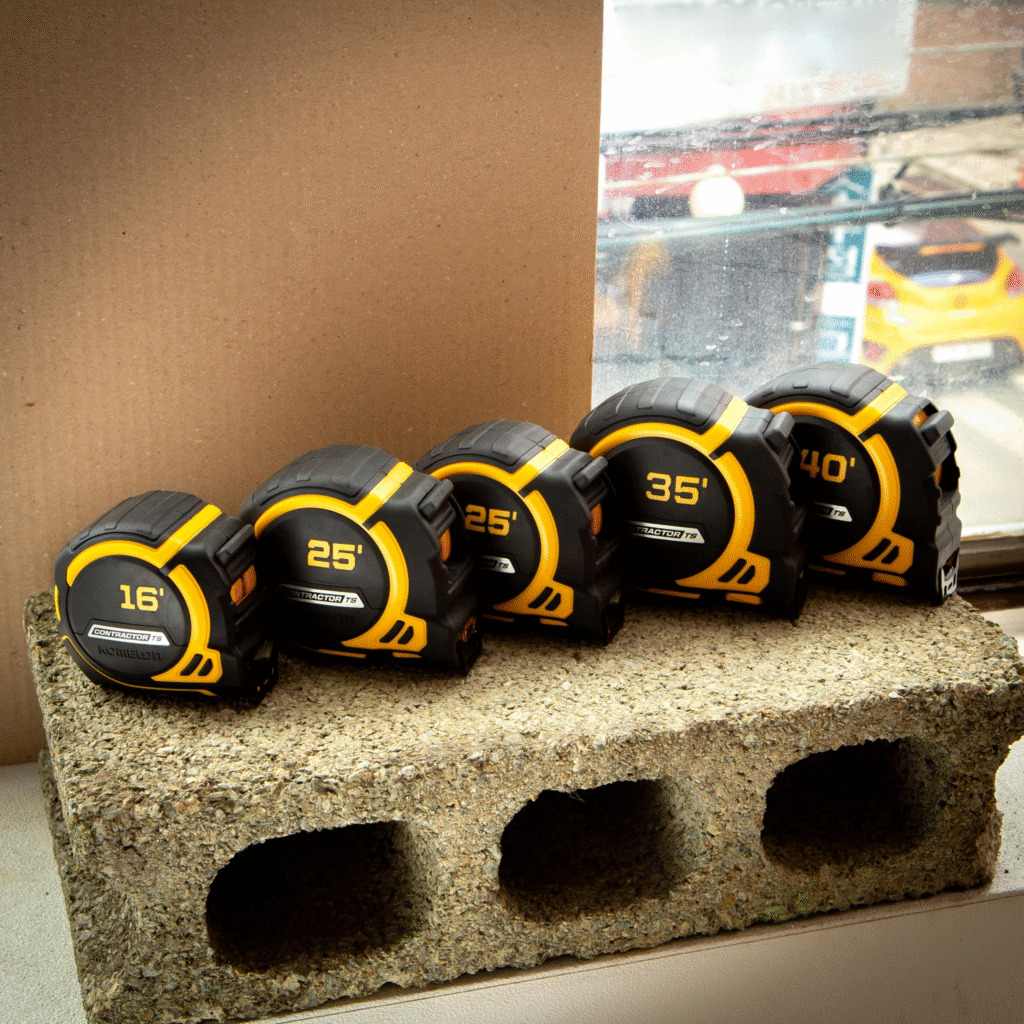
4. Komelon Contractor TS — Best Budget Tape Measure for Homeowners
Price: ~$18 (25 ft) | Blade Width: 1.25 in | Weight: 1.24 lbs | Rated Standout: 12 ft
The Short Review
At roughly half the price of our top picks, the Komelon Contractor TS shouldn’t perform this well—but it does. It scored 90 points in our testing, just shy of premium tapes costing twice as much, and proved that “budget” doesn’t have to mean “disposable.”
The finger brake is the best-designed in our entire test group. The cutout is perfectly positioned, the resistance is tuned just right, and controlling blade retraction feels natural from the first use. If you’ve ever had a tape snap back and nick your finger, you’ll appreciate this immediately.
The compact body is comfortable to hold and easy to pocket. The overmolded lock button has a positive click that tells you it’s engaged. The reinforced hook mount improves durability at the most stress-prone point. And the double-sided printing with clear, bold markings is easy to read in normal lighting.
In our durability testing, the blade showed some flattening after abuse—more than the Lufkin or Milwaukee, but less than the Craftsman. It remained perfectly usable. The nylon coating is adequate for home use, though it won’t survive the punishment that EXO360 or Rip-Shield handles.
The standout reach of 11 feet 5 inches is respectable but not exceptional. For measuring rooms, furniture, and standard lumber, it’s plenty. For wide spans or deep reaches, you’ll need a helper or a premium tape.
The one quality-control issue we found: a sharp burr on the inside of the belt clip on our test unit. A quick file fixed it, but check yours before carrying it.
Buy this if: Your budget is under $20, you need a reliable tape for occasional to moderate home use, or you want the best finger brake design available.
Skip this if: You measure professionally or daily, need maximum standout, or want the absolute toughest blade coating.
Pros
- Best value in our testing—performs near premium level at half the price
- Best finger brake design in the test group
- Compact, comfortable body
- Reinforced hook mount for improved durability
- Overmolded lock button with positive feel
- Double-sided printing
- Respectable 11 ft 5 in horizontal reach
Cons
- Blade showed some flattening in abuse testing
- Nylon coating less durable than premium alternatives
- Lower standout than top-tier competitors
- Potential sharp burr on belt clip—check before use
5. Stanley FatMax Premium — Best Classic Tape Measure for Home Use
Price: ~$31 (25 ft) | Blade Width: 1.25 in | Weight: 1.23 lbs | Rated Standout: 17 ft
The Short Review
Ask any group of contractors or serious DIYers which tape measure they trust, and “FatMax” comes up more than any other name. Stanley built that reputation over decades, and the FatMax Premium largely lives up to it—though our 2026 testing revealed it’s no longer the undisputed king.
The standout performance is excellent. In our tests, it reached 12 feet 10 inches horizontally and dropped only 15.13 inches at 8 feet—third-best in the group. The blade stiffness is outstanding, and the textured case offers a grip that feels secure even with dusty or gloved hands. Double-sided printing and a finger brake round out the feature set.
The BladeArmor coating on the first six inches provides extra protection where it’s needed most. The hook is appropriately sized and grips well on most materials.
However, our blade abuse test exposed a weakness the FatMax name usually doesn’t carry: the blade cracked under sustained punishment. While it survived most of the test and remained technically usable, that crack would spread and eventually break off. The Crescent Lufkin, Milwaukee, and DeWalt all emerged unscathed from the same test.
The hook connection is also looser than we’d like. For most measurements this doesn’t affect accuracy—the hook play is designed into the tape to compensate for inside vs. outside measurements—but it feels less precise than the Lufkin’s tight, solid hook.
And the belt clip, while functional, is stamped steel that can bend and eventually fail with heavy use.
Buy this if: You trust the FatMax name, want excellent standout and grip, or prefer a tape with proven field history.
Skip this if: You want the absolute toughest blade, need a more durable belt clip, or want the best value in the premium category.
Pros
- Excellent horizontal reach (12 ft 10 in)
- Outstanding blade stiffness
- Textured case with excellent grip
- BladeArmor coating on first six inches
- Finger brake for controlled retraction
- Double-sided printing
- Trusted name with decades of field history
Cons
- Blade cracked in our abuse test—less durable than top competitors
- Loose hook connection
- Stamped steel belt clip prone to bending
- Premium price without matching premium durability
Complete Buying Guide: How to Choose the Right Tape Measure
What Makes a Great Tape Measure?
A tape measure seems simple—pull it out, read the number, done. But the difference between a great tape and a frustrating one shows up in the details that matter every single time you use it.
Standout is how far the blade extends horizontally before collapsing under its own weight. More standout means measuring across wider gaps without a helper. For home use, 10–12 feet is usually sufficient. For pros or large projects, 14+ feet saves time and hassle.
Blade Coating protects against abrasion, moisture, and the daily wear of sliding against wood, metal, and concrete. Premium coatings like EXO360 and Rip-Shield significantly extend blade life. Basic nylon coatings work fine for occasional use but degrade faster.
Hook Design matters more than you’d think. A larger hook catches edges more easily. A diamond-coated or textured hook grips better on smooth surfaces. Magnetic hooks are invaluable for metal work. And hook play—the slight movement that compensates for inside vs. outside measurements—must be precise or your readings will be off.
Readability depends on marking contrast, number size, and printing quality. Reverse-contrast or high-contrast markings are easier to read in dim light. Extra-large numbers reduce eye strain. Double-sided printing lets you read from any blade orientation.
Housing Durability determines how well your tape survives drops, kicks, and weather. Overmolded rubber grips absorb impact. Solid internal construction prevents the blade from binding after a fall.
Key Specs Explained
Blade Width — Wider blades (1.25 inches) are stiffer and offer better standout. Narrower blades (1 inch) are lighter and more compact but sag sooner.
Standout vs. Reach — Manufacturers rate “standout” under ideal conditions. Real-world “reach” is typically 2–4 feet less due to humidity, temperature, and blade coating thickness.
Hook Movement — The hook slides slightly to compensate for inside measurements (hook compressed) vs. outside measurements (hook extended). “Normal” movement is correct. “Loose” or “stiff” hooks affect accuracy.
Finger Brake — A cutout or lever that lets you slow blade retraction with your finger. Prevents the blade from snapping back too quickly and gives you precise control when measuring to a specific point.
What We Learned After Testing 8+ Tapes Head-to-Head
Blade coating quality varies enormously. Running your finger along the blade tells you more than any spec sheet. The best coatings feel thick, smooth, and substantial. Cheap coatings feel thin and wear visibly after a few weeks of use.
Standout ratings are optimistic. Every tape we tested fell short of its manufacturer-rated standout in real-world conditions. Plan on 2–4 feet less than advertised.
Most tapes are surprisingly accurate. Every tape in our test group measured within acceptable tolerances for length. The differences show up in durability, standout, and usability—not basic accuracy.
The finger brake is underrated. Once you use a tape with a well-designed finger brake, going back to a basic side-lock feels clumsy and slow.
Housing shape matters for comfort. Rounded edges and overmolded grips reduce hand fatigue during long measuring sessions. Squared-off cases create pressure points.
Price Ranges — What to Expect
Budget ($8–$18): Basic tapes with 7–10 foot standout, simple nylon coating, stamped steel clips, and no finger brake. Fine for occasional home use. Examples: Stanley PowerLock, basic Komelon models.
Mid-Range ($18–$28): The sweet spot for most homeowners. Better blade coatings, improved standout, finger brakes, and more durable housings. Examples: Komelon Contractor TS, Crescent Lufkin standard models.
Premium ($28–$35): Professional-grade standout, advanced blade coatings, reinforced hooks, and jobsite-tough construction. Examples: Crescent Lufkin Shockforce Nite, Milwaukee Stud, DeWalt ToughSeries, Stanley FatMax Premium.
Specialty ($100+): Digital tape measures with laser distance, Bluetooth connectivity, and app integration. Overkill for most homeowners but useful for specific applications. Example: Reekon T1 Tomahawk.
Final Tips Before You Buy
Feel before you buy if possible. Grip the tape, extend the blade, test the lock, and check the brake. Comfort and intuitiveness matter more than specs.
Check the first six inches. This is where most blade damage occurs. Look for extra reinforcement, anti-tear coating, or BladeArmor-style protection.
Test the hook on actual material. Hook it onto a 2×4 edge, a rounded pipe, and a smooth metal surface. Does it grip? Does it slip? Does it feel solid?
Buy the length you actually use. A 25-foot tape covers 95% of home projects. A 16-foot tape is more pocketable but limits you on outdoor or large-room measurements. A 35-foot tape is overkill unless you’re doing construction or landscaping.
Replace your tape when the blade shows wear. A stretched, cracked, or faded blade gives inaccurate readings. For a tool you use constantly, $25 every few years is cheap insurance against measurement mistakes.
Frequently Asked Questions
Q: How accurate are tape measures, really?
A: Quality tape measures are accurate to within 1/32 of an inch over their full length. In our testing, every premium tape measured within acceptable tolerances. The real accuracy killers are worn blades, bent hooks, and user error (not reading at eye level, pulling too hard, or measuring from the wrong point).
Q: Why does the hook move? Is my tape broken?
A: No—the hook slides slightly by design. When you hook onto the edge of a board (outside measurement), the hook slides out and includes its own thickness in the reading. When you push the tape against an inside corner (inside measurement), the hook slides in and the reading starts from the tape’s end. This compensation is built into every quality tape. If the hook doesn’t move at all, or moves excessively, then you have a problem.
Q: What’s the difference between a 16-foot and 25-foot tape?
A: A 16-foot tape is lighter, more compact, and fits comfortably in a pocket. It’s fine for furniture, picture frames, and small rooms. A 25-foot tape is the standard for home construction, room measurements, and outdoor projects. Most homeowners should start with 25 feet.
Q: Do I need a magnetic hook?
A: Only if you frequently measure against steel studs, metal framing, ductwork, or machinery. For wood, drywall, and most home projects, a standard hook works fine. The DeWalt ToughSeries offers a removable magnet if you want flexibility.
Q: Why did my tape measure blade crack?
A: Blades crack from repeated bending, abrasion against rough surfaces, or impact damage to the first few inches. Premium coatings and reinforced hook mounts prevent this. If your tape cracks, replace it immediately—a cracked blade will snap and can cause injury.
Q: How do I clean and maintain my tape measure?
A: Wipe the blade with a dry cloth after use, especially if it’s been exposed to moisture or sawdust. A light spray of silicone lubricant on the blade helps it retract smoothly. Avoid dropping the tape on hard surfaces, and don’t let the blade snap back uncontrolled—the impact stresses the spring and hook mount.
Q: Are laser tape measures better than traditional tapes?
A: For long distances (over 30 feet) and area/volume calculations, yes. For everyday tasks like checking lumber length or furniture dimensions, a traditional tape is faster and more intuitive. Many pros carry both. For home use, start with a quality traditional tape and add a laser measure later if you do renovation work.
Q: What’s the best tape measure for a woman with smaller hands?
A: The Komelon Contractor TS is compact and comfortable for smaller grips. The Crescent Lufkin Shockforce Nite is also well-balanced despite its capabilities. Avoid bulky contractor-grade tapes unless you need the extra durability.
Q: Can I use a tape measure in the rain?
A: Brief exposure won’t ruin a quality tape, but prolonged moisture can rust the blade and weaken the spring. Wipe it dry immediately. If you work outdoors frequently, look for tapes with water-resistant coatings.
Q: When should I replace my tape measure?
A: Replace it when the blade shows cracks, the numbers fade, the hook becomes loose or bent, the spring weakens (blade doesn’t retract fully), or measurements seem inconsistent. A $25 tape measure is cheaper than a ruined $500 project.
Disclosure: We independently research and test products. When you buy through links on our site, we may earn an affiliate commission at no extra cost to you.