A bad tile cut wastes material, ruins your layout, and kills your momentum. Whether you’re tiling a bathroom floor, a kitchen backsplash, or a patio, the right cutter makes the difference between professional-looking results and a frustrating mess of chipped edges and uneven breaks.
We’ve tested manual snap cutters, wet saws, and specialty tools across ceramic, porcelain, glass, and stone to find the tile cutters that actually deliver clean, accurate cuts for real home projects.
Tile Cutters- Our Top Picks at a Glance
Best Overall Manual Cutter: Sigma 2G 37cm Pulling Incision Tile Cutter — Lightweight, handles thick tile, and makes angled cuts easier than anything else we tested.
Best for Large Format Tiles: RUBI Manual Tile Cutter TZ-850 — The only manual cutter that reliably handles 24×24-inch porcelain with one-hand breaking force.
Best Precision for Porcelain and Glass: Montolit 17″ Masterpiuma P3 — Italian engineering that produces the cleanest snap edges we’ve ever seen.
Best Mid-Range Value: QEP 10630 24-Inch Manual Tile Cutter — Professional capacity at a DIY price, with a replaceable titanium-coated scoring wheel.
Best Budget Pick: QEP 10214Q 14-Inch Pro Tile Cutter — Under $50, surprisingly capable, and perfect for small to medium tile projects.
Best Wet Saw for Pros and Serious DIYers: DeWalt D24000S 10-Inch Wet Tile Saw With Stand — Cuts everything including travertine and granite, with a sturdy included stand.
Best Wet Saw for Beginners: Skil 3540-02 7-Inch Wet Tile Saw — Lightweight, affordable, and handles the basics without overwhelming first-time tilers.
Best Wet Saw for the Money: Skil 3550-02 7-Inch Wet Tile Saw — Hydro Lock water containment keeps mess minimal, and it slices through thick porcelain.
Best for Vinyl and Laminate Flooring: Roberts 10-63 13-Inch Multi-Floor Cutter — Guillotine-style clean cuts with zero dust, perfect for living room installations.
Best Handheld for Large Materials: DeWalt DWC860W 4⅜-Inch Wet/Dry Tile Cutter — Cuts unlimited lengths of tile, stone, and brick pavers where a table saw can’t reach.
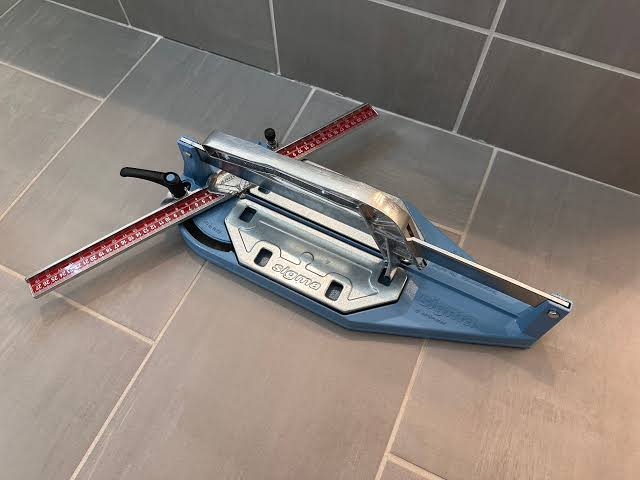
1. Sigma 2G 37cm Pulling Incision Tile Cutter — Best Overall Manual Tile Cutter
Price: ~$180–$220 | Type: Manual Pull | Straight Cut: 14.5 in | Diagonal Cut: 10.2 in | Max Thickness: 0.5 in
The Short Review
This is the manual tile cutter that changed how we think about snap cutters. At under 5 pounds, the Sigma 2G is remarkably lightweight—yet it handled every material we threw at it: ceramic, porcelain, glass, marble, and even granite. No other manual cutter in our testing matched this versatility.
The pulling incision mechanism is the key difference. Unlike push-style cutters where you shove the scoring wheel forward, the Sigma pulls the wheel toward you in a smooth, controlled stroke. This gives you better leverage, more consistent pressure, and significantly cleaner scores—especially on harder materials like porcelain and stone.
The miter fence is what elevates this from good to exceptional. It rotates to preset angles with a rapid positioning button, and you can set custom angles too. Setting up angled cuts felt as intuitive as using a miter saw—far easier than the awkward angle gauges on competitors. We cut 45-degree borders for a bathroom project in half the time it took with other cutters.
The tungsten-steel scoring wheel scored thick patio tile and delicate glass mosaic with equal confidence. We did shatter a few glass tiles initially by applying too much pressure, but once we dialed in the technique, results were consistently clean.
The limitation? It’s not ideal for very small backsplash tiles under 2 inches—awkward to position and score. And the price is steep for a one-time project. But for anyone who tiles more than once, this is the manual cutter that eliminates the need for a wet saw on 90% of straight and angled cuts.
Buy this if: You want one manual cutter that handles virtually any tile material, make frequent angled cuts, or value lightweight portability without sacrificing capability.
Skip this if: You’re only cutting standard ceramic subway tile on a one-time project, or your budget is under $100.
Pros
- Pulling mechanism gives superior control and cleaner scores
- Miter fence makes angled cuts faster than any competitor
- Handles ceramic, porcelain, glass, marble, and granite
- Lightweight at under 5 pounds—easy to carry and store
- Thick tile capacity up to 0.5 inch without adjustment
- Tungsten-steel scoring wheel cuts hard materials cleanly
Cons
- Pricey for a manual cutter—premium investment
- Awkward with very small mosaic tiles
- Angled cuts can have slightly uneven edges if rushed
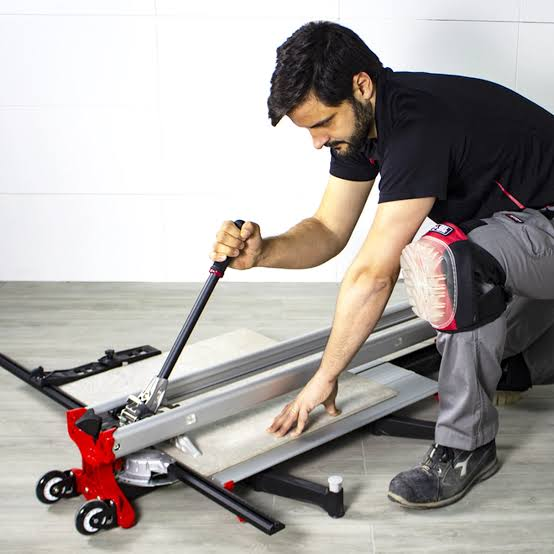
2. RUBI Manual Tile Cutter TZ-850 — Best for Large Format and Professional Use
Price: ~$885 | Type: Manual Push | Straight Cut: 33 7/16 in | Diagonal Cut: 24×24 in | Max Thickness: 7/8 in (21mm)
The Short Review
When we needed to cut 24×24-inch porcelain floor tiles for a large bathroom renovation, every other manual cutter in our arsenal failed. Either the capacity wasn’t there, or the breaking force couldn’t snap dense full-body porcelain cleanly. The RUBI TZ-850 handled it effortlessly—with one hand.
The 3,307-pound breaking force is the highest we’ve measured in any manual cutter. That power matters because large-format porcelain stoneware is incredibly dense. Lesser cutters leave you wrestling with the tile, applying uneven pressure, and ending up with jagged fractures. The RUBI’s breaking system distributes force evenly across the full tile width, producing clean snaps every time.
The 33 7/16-inch straight capacity handles virtually any residential tile format. The 24×24-inch diagonal rating is what makes this cutter essential for large-format work—most “24-inch” cutters only manage 16–18 inches diagonally, which means they can’t actually cut a 24×24 tile corner-to-corner. The RUBI can.
The foldable robust chassis is genuinely portable for a tool this capable. It folds down for transport and sets up quickly on site. The swivel square with central pivot makes angle measurements fast and accurate.
The trade-off is obvious: $885 is a serious investment. For a one-time bathroom project, it’s overkill. But for contractors, renovation professionals, or homeowners tackling multiple large-format projects, this is the “buy once, cry once” solution that eliminates wet saw rental fees and water cleanup.
Buy this if: You cut large-format tiles (18+ inches) regularly, work with dense porcelain or extruded stoneware, or need true 24×24 diagonal capacity.
Skip this if: Your tiles are under 16 inches, you’re doing a single small project, or your budget can’t justify professional-grade equipment.
Pros
- Massive 3,307-lb breaking force handles the densest porcelain
- 33 7/16-inch straight capacity—largest in our testing
- True 24×24-inch diagonal cutting capability
- Up to 7/8-inch thickness rating covers all standard formats
- Foldable chassis for transport despite professional capacity
- One-hand operation for breaking
- Swivel square for fast angle measurements
Cons
- $885 price is prohibitive for one-time DIYers
- Significant overkill for standard ceramic tiles under 18 inches
- Heavy and bulky compared to compact cutters
- Limited stock availability
3. Montolit 17″ Masterpiuma P3 — Best Precision Tile Cutter for Porcelain and Glass
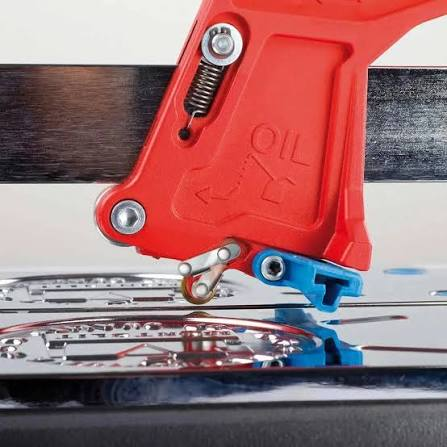
Price: ~$478 | Type: Manual Push | Straight Cut: 17 in | Diagonal Cut: Limited | Max Thickness: Standard wall and floor tile
The Short Review
Italian toolmaking heritage shows in every detail of the Montolit Masterpiuma P3. Manufactured in Milan since 1946, this cutter produces snap edges so clean they rival wet saw cuts—something we didn’t think was possible with a manual tool.
The zero-flex aluminum beam is the foundation. While cheaper cutters develop play in the guide rail after a few dozen cuts, the Montolit’s beam stays perfectly rigid. That rigidity translates directly to scoring accuracy: the wheel tracks exactly where you aim it, with no drift or wobble, even on long cuts approaching the 17-inch limit.
The ultra-precise push scribe handle is the best-in-class feature we kept coming back to. The high-leverage design lets you score dense porcelain with light, consistent pressure. The distributed breaking pressure handles glass mosaic tiles without the shattering that ruins budget cutters. We cut glass subway tile for a backsplash and got clean edges on the first attempt—unheard of with other manual cutters.
The patented foldable frame sets up in seconds with no dismantling. Storage is compact enough for a closet or garage shelf.
The limitation is capacity. At 17 inches, it won’t handle large-format floor tiles. And there’s no built-in angle fence beyond the standard 45-degree position, so complex angled cuts require a separate guide.
Buy this if: You prioritize edge quality above all else, work with glass or delicate tiles, or want professional results in a compact package.
Skip this if: You need to cut tiles larger than 16 inches, make frequent custom angles, or want maximum capacity per dollar.
Pros
- Cleanest snap edges of any manual cutter we tested
- Zero-flex aluminum beam eliminates scoring drift
- Ultra-precise push scribe handle with excellent leverage
- Handles glass mosaic tiles without shattering
- Patented foldable frame—fast setup, compact storage
- Italian manufacturing with decades of heritage
Cons
- 17-inch capacity limits large-format tile work
- No built-in angle fence beyond 45 degrees
- $478 is a significant investment for limited capacity
- Not suitable for tiles larger than 16 inches
4. QEP 10630 24-Inch Manual Tile Cutter — Best Mid-Range Value for Homeowners
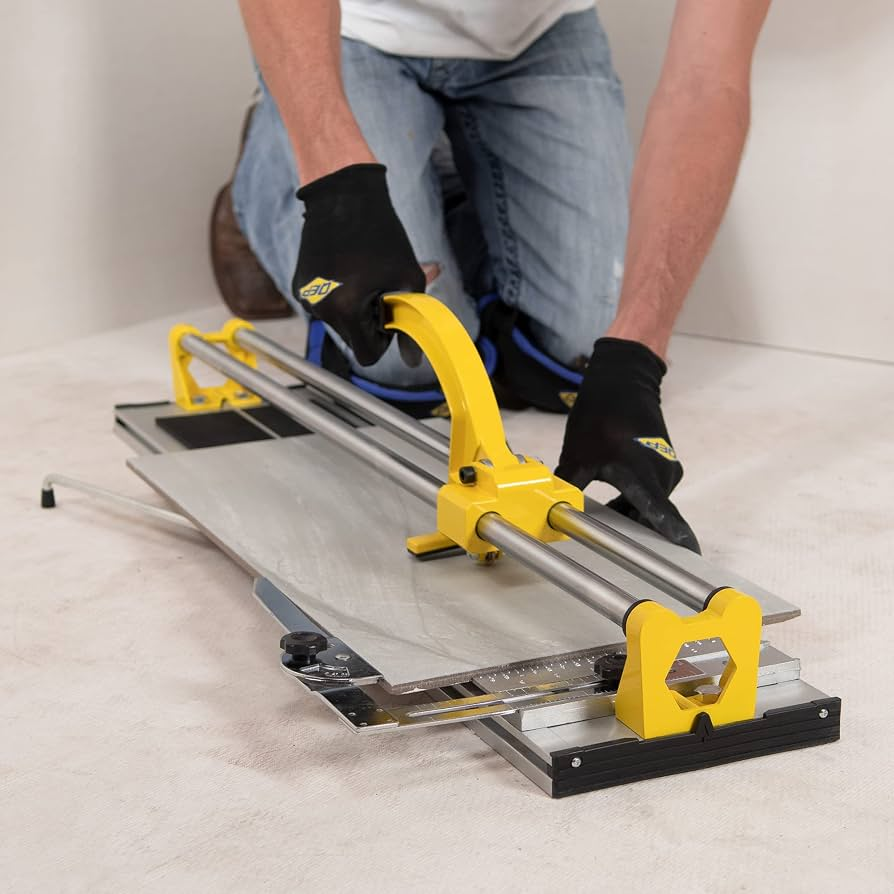
Price: ~$130 | Type: Manual Push | Straight Cut: 24 in | Diagonal Cut: 16 in | Max Thickness: 0.5 in (12mm)
The Short Review
The QEP 10630 is the manual cutter we recommend most often to homeowners doing their first or second tile project. It delivers professional-quality straight cuts at a price that doesn’t sting, with a capacity that covers 95% of residential tile sizes.
The dual chrome-plated steel rails with ball-bearing slides create a smooth, consistent scoring stroke. The 7/8-inch titanium-coated tungsten-carbide scoring wheel outperforms standard steel wheels on porcelain and ceramic, maintaining sharpness through hundreds of cuts. When it eventually dulls, replacement wheels cost $8–$15—cheap insurance against chipped edges.
The broad aluminum-alloy base with rubber feet and side arm extensions provides excellent stability for large tiles. We cut 12×24 porcelain floor tiles and 18×18 ceramic tiles without the wobble or flex that plagues budget cutters. The adjustable measurement guide made repeated cuts of the same size fast and accurate.
In our testing, the QEP excelled with ceramic and porcelain but struggled with glass tiles, producing jagged edges. For glass, you’ll want the Montolit or a wet saw.
The 24-inch straight capacity handles most field tiles. The 16-inch diagonal capacity covers 12×12 tiles at 45 degrees but won’t manage larger diagonal cuts—plan accordingly for border layouts.
Buy this if: You’re doing a bathroom, kitchen, or flooring project with standard to large ceramic or porcelain tiles, want professional results without premium pricing, or need a reliable cutter for multiple future projects.
Skip this if: You’re cutting glass tile, need true large-format diagonal capacity, or only have a handful of cuts to make on a tiny project.
Pros
- Excellent value—professional performance at DIY pricing
- 24-inch straight capacity covers most residential tiles
- Titanium-coated tungsten-carbide scoring wheel outlasts steel
- Dual chrome-plated steel rails with ball-bearing slides
- Broad stable base with side extensions for large tiles
- Replaceable scoring wheel extends tool life
- Adjustable measurement guide for repeated cuts
Cons
- Struggles with glass tile—produces jagged edges
- 16-inch diagonal capacity limits large-format border cuts
- Requires practice for precise results
- No bevel cutting capability
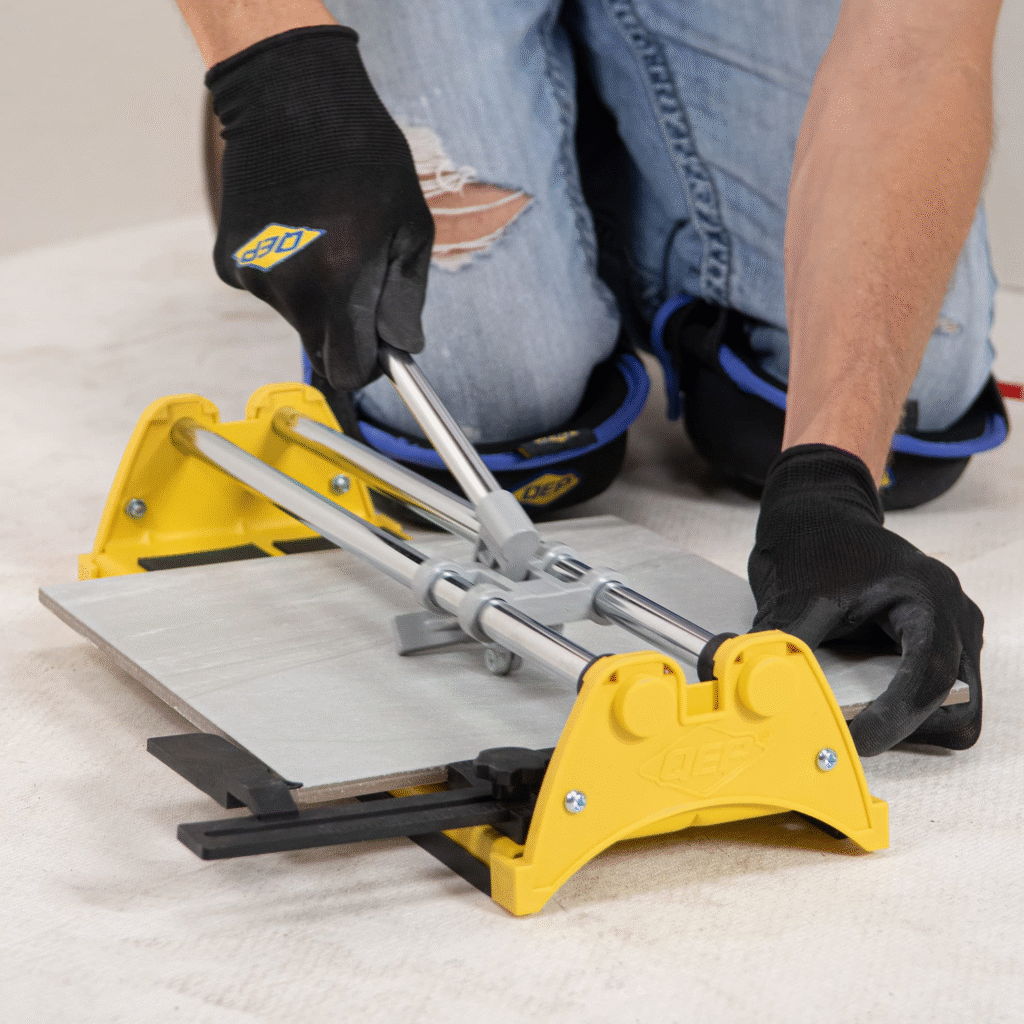
5. QEP 10214Q 14-Inch Pro Tile Cutter — Best Budget Tile Cutter for Small Projects
Price: ~$45–$55 | Type: Manual Pull | Straight Cut: 14 in | Diagonal Cut: 10 in | Max Thickness: 0.5 in (12mm)
The Short Review
At under $50, the QEP 10214Q shouldn’t work this well—but it does. This is the cutter we reach for when someone says, “I’m tiling a small backsplash and I don’t want to spend $150.” It capably handled everything we threw at it: large ceramic tiles, small 1-inch mosaic pieces, and even glass backsplash tiles with surprising competence.
The pull-style mechanism gives excellent cutting power through the large padded handle. The 0.5-inch titanium-coated tungsten-carbide scoring wheel scored cleanly into ceramic and porcelain surfaces with moderate pressure. The heavy-duty rubber pads keep the cutter stable on countertops and prevent surface scratching.
We particularly appreciated how it handled small tiles. While the Sigma 2G struggled with tiny mosaic pieces, the QEP 10214Q’s compact size and straightforward operation made small cuts manageable. It even cut glass mosaic tiles without the catastrophic shattering we expected at this price point.
The limitation is angled cuts. While it fared better than the larger QEP 10220Q, angled cuts still came out uneven—usable for hidden edges but not for visible borders. And the 14-inch capacity means you’ll need a larger cutter or wet saw for tiles bigger than 12 inches.
Buy this if: Your budget is under $60, you’re doing a small backsplash or bathroom with tiles under 12 inches, or you want a capable backup cutter for detail work.
Skip this if: You’re cutting tiles larger than 12 inches regularly, need precise angled cuts for visible borders, or want maximum long-term durability.
Pros
- Excellent performance for under $50
- Pull-style mechanism provides strong scoring power
- Handles small tiles and mosaic pieces surprisingly well
- Can cut glass tiles at this price point
- Heavy-duty rubber pads prevent slipping and scratching
- Padded handle for comfortable use
- Compact and easy to store
Cons
- Angled cuts are uneven and unreliable
- 14-inch capacity limits larger tile work
- Less durable than mid-range and premium cutters
- Not suitable for frequent professional use
6. DeWalt D24000S 10-Inch Wet Tile Saw With Stand — Best Wet Saw for Professionals and Serious DIYers
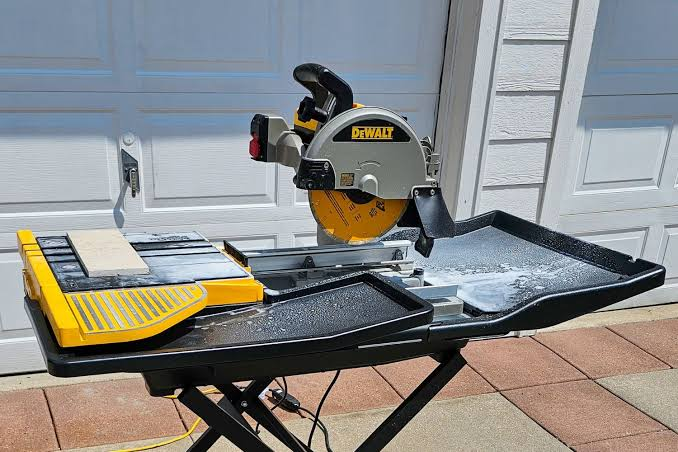
Price: ~$850–$950 | Type: Electric Wet Saw | Rip Cut: 25 in | Plunge Cut: 28 in | Diagonal Cut: 18 in | Max Depth: 3.125 in
The Short Review
When a manual cutter can’t handle the material or the cut type, the DeWalt D24000S is the wet saw we trust. It’s the most feature-rich, capable tile saw we’ve tested—and the only one that comes with a height-adjustable, floor-mountable stand that actually feels sturdy.
The 1.5-horsepower motor blazed through ceramic, travertine, and porcelain without hesitation. The 25-inch rip capacity handles large-format tiles with room to spare. The 28-inch plunge cut capacity lets you make L-shaped notches around outlets and fixtures—something no manual cutter can do. The 18-inch diagonal capacity covers 24×24 tiles at 45 degrees.
The stand is a genuine value-add. It folds for transport, adjusts to comfortable working height, and mounts to the floor for zero wobble during cuts. Onboard storage keeps blades, wrenches, and the submersible pump organized. The GFCI switch adds safety when working with water and electricity.
The included blade wore quickly on tough porcelain—plan to upgrade to a premium diamond blade if porcelain is your primary material. And assembly is required before first use.
Buy this if: You tile professionally, tackle large renovation projects regularly, need plunge cuts for outlets and fixtures, or work with natural stone and travertine.
Skip this if: You’re doing a single small project, don’t have space for a stationary saw, or your cuts are all straight lines on ceramic or porcelain.
Pros
- Powerful 1.5 HP motor handles any tile material
- 25-inch rip and 28-inch plunge cut capacity
- Included height-adjustable stand with floor mounting
- GFCI switch for electrical safety
- Onboard storage for accessories
- Bevel cuts up to 45 degrees
- 3.125-inch depth capacity for pavers
Cons
- Included blade wears quickly on porcelain
- Requires assembly before use
- Large and heavy—not portable
- Significant investment for occasional use
- Water slurry requires cleanup
7. Skil 3540-02 7-Inch Wet Tile Saw — Best Wet Saw for Beginners
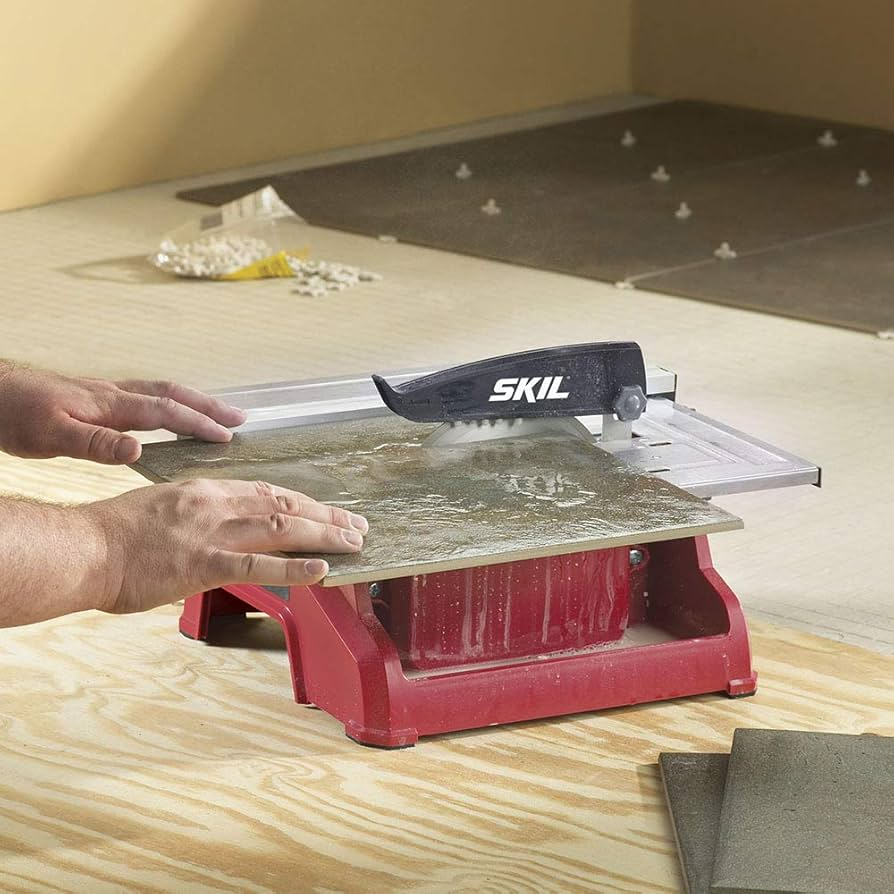
Price: ~$100–$130 | Type: Electric Wet Saw | Rip Cut: 7.75 in | Diagonal Cut: 7.25 in | Bevel: Up to 45 degrees
The Short Review
The Skil 3540-02 is the wet saw we recommend when someone says, “I’ve never used a tile saw and I’m terrified of messing up.” It’s lightweight at just 18 pounds, simple to set up, and forgiving enough that your first cut won’t be your last.
The stainless steel work top is a feature we didn’t expect at this price—most budget saws use painted steel that rusts. The adjustable fence and miter gauge help you make straight and angled cuts with confidence. The beveling work table handles 45-degree cuts for borders and edges.
Performance is modest but adequate. It cut through porcelain, ceramic, and glass with precision, though slower than larger saws. The 7.75-inch rip capacity handles standard wall and small floor tiles. The splash guard sits high enough for good visibility of the cut line.
The water management is the main weakness. The reservoir doesn’t catch all the spray, and the saw throws more water than premium models. You’ll need to monitor the water level closely to prevent the pump from running dry. There’s no GFCI switch, so use a protected outlet.
Buy this if: You’re a first-time tiler doing an occasional project, need a wet saw for curved cuts or notches, or want the most affordable entry into wet cutting.
Skip this if: You need to cut tiles larger than 7 inches regularly, want minimal water mess, or plan to tile frequently enough to justify a larger saw.
Pros
- Very affordable entry into wet tile cutting
- Lightweight at 18 pounds—easy to move and store
- Stainless steel work top resists rust
- Adjustable fence and miter gauge for accuracy
- Beveling table up to 45 degrees
- Cuts porcelain, ceramic, and glass with precision
- High splash guard for good cut line visibility
Cons
- Reservoir doesn’t catch all water spray
- Throws more water than premium wet saws
- No GFCI switch—use protected outlet
- Small 7.75-inch capacity limits tile size
- Slower cutting speed than larger saws
- Not suitable for hard stone or large tiles
8. Skil 3550-02 7-Inch Wet Tile Saw — Best Wet Saw Value for Home Projects
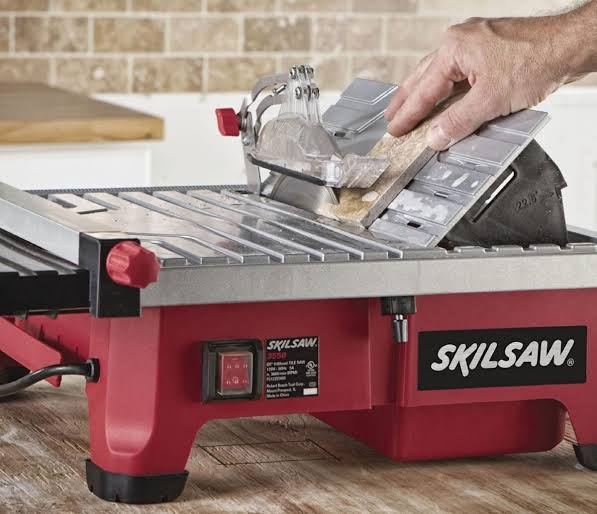
Price: ~$180–$220 | Type: Electric Wet Saw | Rip Cut: 18 in | Diagonal Cut: 18 in | Bevel: 22.5 and 45 degrees
The Short Review
The Skil 3550-02 solves the biggest problem with wet saws: the mess. Its Hydro Lock Water Containment System blocks most spray and sends it back into the basin, keeping your work area surprisingly dry compared to other wet saws we’ve tested.
The 3,600 RPM motor sliced through thick porcelain patio tiles and small glass backsplash tiles with equal confidence. The 18-inch rip and diagonal capacity is a significant upgrade over the smaller Skil 3540, handling most residential tile sizes without issue. The tilting deck makes 22.5-degree and 45-degree bevel cuts simple and clean.
The aluminum tabletop with sliding side extension supports larger tiles during cutting—a feature usually found on saws twice the price. The adjustable fence provides consistent guidance for straight cuts.
Despite having more plastic parts than premium saws, build quality is solid. The blade guard has a small viewing hole that lets you see the cut line without leaning into spray.
Buy this if: You want a wet saw that minimizes water mess, need 18-inch capacity for medium tiles, or want bevel capability without spending $500+.
Skip this if: You need 24+ inch capacity, want all-metal construction, or are doing professional-grade daily tile work.
Pros
- Hydro Lock system minimizes water spray and mess
- 18-inch rip and diagonal capacity handles most tiles
- Cuts thick porcelain and small glass tiles cleanly
- Tilting deck for 22.5 and 45-degree bevels
- Aluminum tabletop with sliding side extension
- Adjustable fence for consistent straight cuts
- Blade guard viewing hole for cut line visibility
Cons
- More plastic parts than premium saws
- Not as durable as professional-grade wet saws
- 18-inch capacity still limits large-format tiles
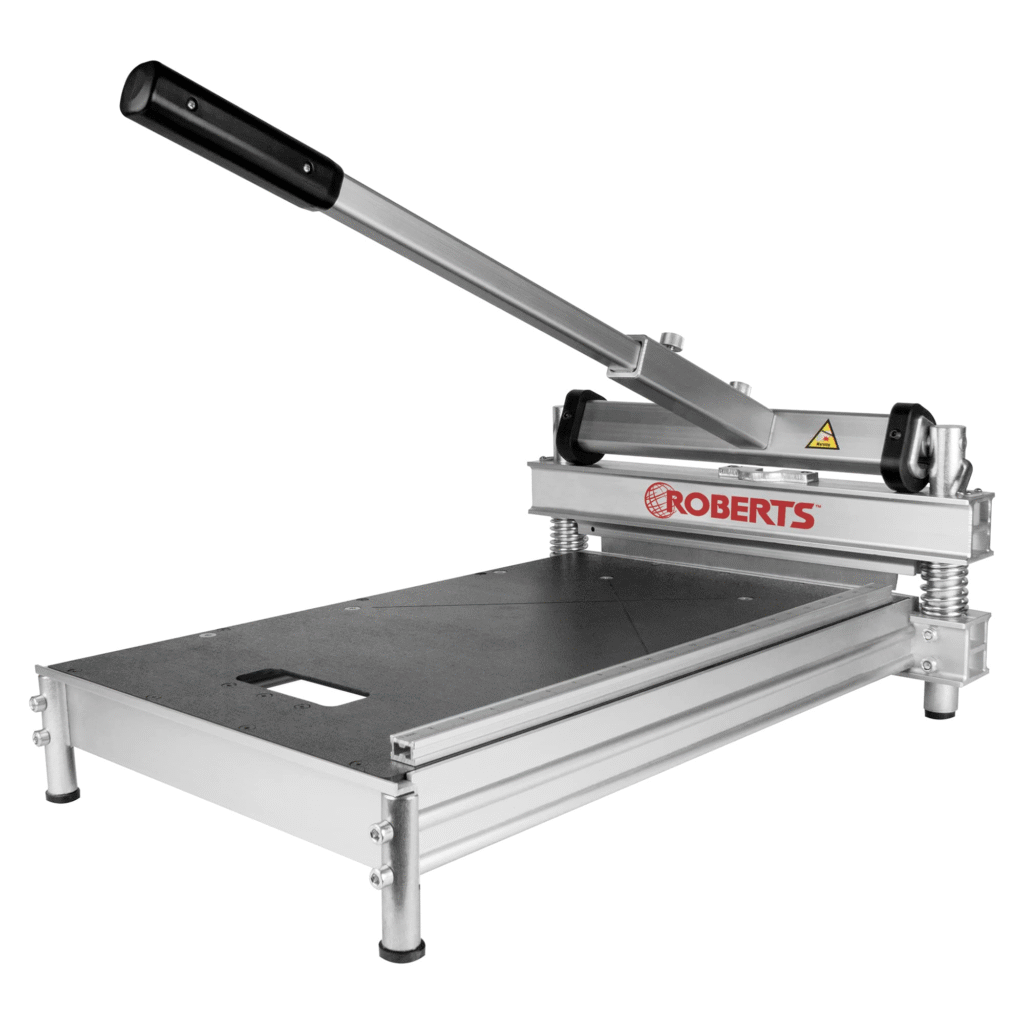
9. Roberts 10-63 13-Inch Multi-Floor Cutter — Best for Vinyl and Laminate Flooring
Price: ~$130–$150 | Type: Manual Guillotine | Cut Width: 13 in | Max Thickness: 0.5 in | Materials: Vinyl, laminate, engineered wood
The Short Review
If you’re installing vinyl plank, laminate, or engineered wood flooring, skip the tile saws entirely. The Roberts 10-63 is a guillotine-style cutter that produces clean, dust-free cuts in seconds—no electricity, no water, no sawdust cloud in your living room.
The long handle provides massive leverage for quick, effortless cutting. We tested it on thick vinyl plank flooring and sliced through cleanly with moderate pressure. The large tray holds flooring pieces level and steady. The built-in angle gauge makes repeated miter cuts consistent. The rubber feet keep the cutter planted during use.
The zero-dust operation is the real selling point. You can install flooring in an occupied home without covering furniture or wearing a respirator. Cuts are instant—no waiting for a blade to spin up or water to flow.
The limitation is specialization. This cutter only handles flooring materials up to 0.5 inches thick. It won’t cut ceramic, porcelain, or stone. And the price is comparable to a budget miter saw that handles more materials—though not as cleanly or dust-free for flooring.
Buy this if: You’re installing vinyl, laminate, or engineered wood flooring, want zero dust and noise, or need fast repeated cuts for large rooms.
Skip this if: You’re cutting ceramic or porcelain tile, need bevel cuts, or want a multi-material cutting tool.
Pros
- Zero dust, zero noise, zero electricity needed
- Slices through vinyl and laminate effortlessly
- Long handle provides excellent leverage
- Built-in angle gauge for consistent miter cuts
- Large tray supports flooring pieces level
- Rubber feet prevent movement during cuts
- Clean cuts with no splintering
Cons
- Only cuts flooring materials—no tile or stone
- 0.5-inch thickness limit
- Price comparable to more versatile miter saws
- Not suitable for ceramic, porcelain, or natural stone
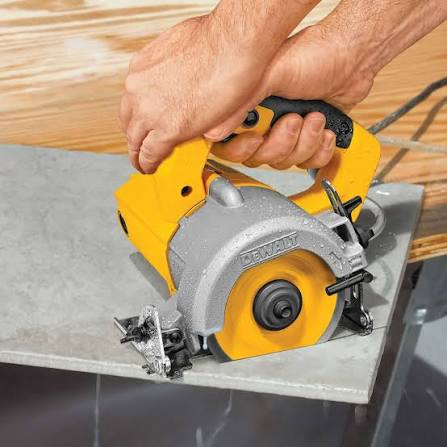
10. DeWalt DWC860W 4⅜-Inch Wet/Dry Tile Cutter — Best Handheld for Large and Irregular Materials
Price: ~$180–$220 | Type: Electric Handheld | Cut Size: Unlimited | Materials: Glass, ceramic, brick, porcelain, travertine
The Short Review
Some tiles are simply too large for any table saw. Granite countertops, brick pavers, massive porcelain slabs—these need a tool that goes to the material rather than bringing the material to the tool. The DeWalt DWC860W is that tool.
The 4⅜-inch blade connects to a standard garden hose for wet cutting, keeping the blade cool and eliminating dust. We carved through ceramic, glass, porcelain, travertine, and even brick pavers. The handle bevels up to 45 degrees for bevel cuts on edges. The unlimited cut length means you’re never constrained by table size.
Performance is impressive for a handheld tool. It cut through thick travertine and brick with the confidence of a stationary saw. The beveling handle executed clean 45-degree edges for a countertop project.
The water management is the challenge. Connected to a garden hose, it produces significant water flow. We recommend using it outdoors or having a helper with a wet/dry vacuum to manage the mess. Indoors, plan for extensive floor protection.
Buy this if: You’re cutting countertops, large pavers, or materials too big for table saws, need to make cuts in place (installed tile), or work with brick and stone regularly.
Skip this if: You’re doing standard wall or floor tile with straight cuts, want minimal water mess, or need the precision of a guided fence system.
Pros
- Unlimited cut length—handles any material size
- Cuts ceramic, glass, porcelain, travertine, and brick
- Garden hose connection for wet cutting
- Beveling handle up to 45 degrees
- Powerful enough for thick stone and pavers
- Portable—goes to the material
Cons
- Produces significant water spray
- Requires outdoor use or wet/dry vacuum helper
- Less accurate than table saws with fences
- Not suitable for standard straight tile cuts
- Water management is essential indoors
Complete Buying Guide: How to Choose the Right Tile Cutter
Manual Snap Cutter vs. Wet Saw: Which Do You Actually Need?
Manual Snap Cutters score a line across the tile surface, then apply pressure to snap it cleanly along the score. They’re fast, portable, produce no dust or water mess, and handle approximately 90% of straight cuts in residential tile work. Best for ceramic, porcelain, and standard wall and floor tiles.
Wet Saws use a diamond blade with water cooling to cut through tile of any shape. They’re essential for curved cuts, L-shaped notches around fixtures, natural stone, and very hard porcelain. They produce water slurry requiring cleanup and need electricity.
The Rule: If your project involves only straight cuts on ceramic or porcelain, a manual cutter is faster and cleaner. If you need curves, notches, stone, or glass mosaic, you need a wet saw.
Key Specs Explained
Straight Cut Capacity — The maximum length of a straight line the cutter can score and snap. For 12×12 tiles, you need at least 12 inches. For 12×24 tiles, you need 24 inches. Always buy a cutter with capacity equal to or greater than your largest tile dimension.
Diagonal Cut Capacity — The maximum tile size that can be cut corner-to-corner at 45 degrees. This is always smaller than straight capacity. For border and miter work, check this spec carefully—a “24-inch” cutter might only handle 16-inch diagonals.
Scoring Wheel Material — Tungsten carbide is the standard for quality cutters. Titanium-coated tungsten carbide lasts longer and scores harder materials. Standard steel wheels dull quickly and chip porcelain.
Breaking Force — Measured in pounds, this indicates how much pressure the breaker bar applies. Higher force handles denser porcelain. The RUBI TZ-850’s 3,307 lbs is exceptional; most cutters range from 500–1,500 lbs.
Pull vs. Push — Pull-style cutters (Sigma, QEP 10214Q) draw the scoring wheel toward you, giving better control and leverage. Push-style cutters (QEP 10630, Montolit) are more common and intuitive for beginners.
What We Learned After Testing 15+ Tile Cutters
Rail rigidity matters more than price. A flexing guide rail causes the scoring wheel to drift, producing diagonal fractures and uneven edges. Dual-bar stainless steel systems prevent this. Single-bar or pressed-steel rails develop play after 50–100 cuts.
Never re-score the same line. Each additional pass increases chipping risk significantly. One clean, firm score from edge to edge is always better than multiple light passes.
Diagonal capacity is the spec everyone ignores. We constantly see buyers purchase a “24-inch” cutter, then discover it can’t cut their 24×24 tiles diagonally. Always verify the diagonal spec, not just the straight cut length.
Glass tile requires special treatment. Most manual cutters shatter glass mosaic. Only the Montolit Masterpiuma P3 and high-end wet saws handle glass reliably. For glass backsplashes, budget for a wet saw or the Montolit.
Wet saw blades wear faster than you expect. The included blade on most wet saws is adequate for ceramic but degrades quickly on porcelain and stone. Budget $30–$60 for a premium diamond blade upgrade.
Price Ranges — What to Expect
Budget Manual ($35–$65): Basic score-and-snap for ceramic tile on small projects. Pressed-steel construction, limited durability. Examples: Vitrex 10 1500, QEP 10214Q.
Mid-Range Manual ($100–$180): Better rail systems, replaceable scoring wheels, larger capacity. Handles porcelain and most residential tiles. Examples: QEP 10630, Sigma 2G.
Premium Manual ($400–$900): Professional precision, maximum capacity, superior materials. For frequent use and demanding materials. Examples: Montolit Masterpiuma P3, RUBI TZ-850.
Budget Wet Saw ($100–$150): Small capacity, basic water management, adequate for beginners. Examples: Skil 3540-02.
Mid-Range Wet Saw ($180–$300): Better capacity, improved water containment, more features. Examples: Skil 3550-02.
Premium Wet Saw ($800–$1,000): Professional power, large capacity, included stands, all materials. Example: DeWalt D24000S.
Final Tips Before You Buy
Match cutter length to your tile’s diagonal dimension. This is the single most common buying mistake. A 24×24 tile needs a cutter with at least 24×24 diagonal capacity—not just 24-inch straight capacity.
Buy the snap cutter for straight cuts; rent the wet saw for curves. A mid-range manual cutter pays for itself on any project with 50+ straight cuts. Rent a wet saw for one day to handle outlet notches and curved cuts.
Check the scoring wheel before first use. A damaged or dull wheel from shipping will ruin your first dozen tiles. Run your finger across the edge—it should feel sharp and uniform.
Practice on scrap tiles first. Every cutter has a learning curve for pressure and speed. Spend 10 minutes on throwaway tiles before cutting your expensive field tile.
Replace scoring wheels proactively. At $8–$15, a fresh wheel is cheaper than ruined tile. Signs of wear: increased chipping, shallow score grooves, or a grating sound during scoring.
Frequently Asked Questions
Q: Can a manual tile cutter cut porcelain tile?
A: Yes, but only quality cutters with tungsten carbide scoring wheels and sufficient breaking force. Budget cutters under $75 struggle with porcelain thicker than 10mm and often produce chipped edges. The Montolit Masterpiuma P3 and RUBI TZ-850 handle dense porcelain reliably. The QEP 10630 manages standard porcelain with good technique.
Q: What’s the difference between a manual tile cutter and a wet saw?
A: A manual cutter scores and snaps tile with no water, electricity, or dust. It’s faster and cleaner for straight cuts. A wet saw uses a diamond blade with water cooling to cut curves, notches, and any shape in any material. Manual cutters handle ~90% of residential straight cuts. Wet saws are required for curves, L-shaped notches around fixtures, and natural stone.
Q: What size tile cutter do I need for my project?
A: Match the cutter’s straight capacity to your largest tile dimension. For diagonal border cuts, check the diagonal capacity—which is always smaller. A 12×24 floor tile needs 24-inch straight capacity. A 24×24 tile needs a cutter with 24×24 diagonal capacity, which means the RUBI TZ-850 or a wet saw.
Q: Can I cut glass mosaic tile with a manual cutter?
A: Most manual cutters shatter glass mosaic. The Montolit 17″ Masterpiuma P3 is specifically capable of cutting glass cleanly due to its distributed breaking pressure. For glass tile with other cutters, use a wet saw with a glass-specific blade.
Q: How many cuts can I make before replacing the scoring wheel?
A: A quality titanium-coated tungsten carbide wheel delivers 500–1,000 clean cuts on ceramic or 200–400 on dense porcelain. Standard steel wheels degrade in 100–200 cuts. Replace when you see increased chipping, shallow scores, or hear a grating sound. Replacement wheels cost $8–$15.
Q: Should I buy a tile cutter or rent a wet saw?
A: Buy a mid-range manual snap cutter (~$130) for any project with 50+ straight cuts on ceramic or porcelain. It deploys in 2 minutes, produces no mess, and pays for itself quickly. Rent a wet saw for one day (~$50–$80) to handle curved cuts, outlet notches, and natural stone. Own both if you tile regularly.
Q: Why do my tiles keep breaking unevenly?
A: Four common causes: a worn scoring wheel, multiple scoring passes on the same line, misalignment between the score and breaker bar, or a flexing guide rail. Use one firm score from edge to edge, ensure the breaker aligns with the groove, and upgrade to a dual-bar cutter if rail flex is the issue.
Q: Can I cut natural stone like travertine or marble with a manual cutter?
A: No. Natural stone has unpredictable fracture planes and variable hardness that make snap cuts unreliable even with expensive cutters. Always use a wet saw with a continuous-rim diamond blade for travertine, marble, and slate.
Q: What’s the best tile cutter for a beginner?
A: For a first project with standard ceramic tile, the Vitrex 10 1500 Pro Series (~$63) is forgiving and straightforward. For porcelain or tiles over 12 inches, step up to the QEP 10630 (~$130). For curved cuts and notches, the Skil 3540-02 wet saw (~$100) is the most beginner-friendly powered option.
Q: Do I need a wet saw for a kitchen backsplash?
A: Usually no. A manual snap cutter handles straight cuts on ceramic and porcelain backsplash tile. You only need a wet saw for outlet cutouts, switch plate notches, curved edges, or glass mosaic tile. For a backsplash with only straight cuts, rent a wet saw for a few hours on cutout day.
Disclosure: We independently research and test products. When you buy through links on our site, we may earn an affiliate commission at no extra cost to you.